The Federalist No. 68: A Defense of the Electoral College

As has become customary after a closely divided election (especially, one where the popular vote winner loses in the electoral college), there is a growing chorus of individuals calling for the abolishment of the electoral college. Just last night on Real Time With Bill Maher, former Attorney General Eric Holder called for an end to the electoral college.

I suspect these debates will continue not just this year, but in future elections, as well, and so I thought it might be useful to spotlight The Federalist No. 68, wherein Alexander Hamilton explains why the Framers created the electoral college system.

The mode of appointment of the chief magistrate of the United States is almost the only part of the system, of any consequence, which has escaped without severe censure, or which has received the slightest mark of approbation from its opponents. The most plausible of these, who has appeared in print, has even deigned to admit, that the election of the president is pretty well guarded. I venture somewhat further; and hesitate not to affirm, that if the manner of it be not perfect, it is at least excellent. It unites in an eminent degree all the advantages; the union of which was to be desired.

It was desireable, that the sense of the people should operate in the choice of the person to whom so important a trust was to be confided. This end will be answered by committing the right of making it, not to any pre-established body, but to men, chosen by the people for the special purpose, and at the particular conjuncture.

It was equally desirable, that the immediate election should be made by men most capable of analizing the qualities adapted to the station, and acting under circumstances favourable to deliberation and to a judicious combination of all the reasons and inducements, which were proper to govern their choice. A small number of persons, selected by their fellow citizens from the general mass, will be most likely to possess the information and discernment requisite to so complicated an investigation.

It was also peculiarly desirable, to afford as little opportunity as possible to tumult and disorder. This evil was not least to be dreaded in the election of a magistrate, who was to have so important an agency in the administration of the government, as the president of the United States. But the precautions which have been so happily concerted in the system under consideration, promise an effectual security against this mischief. The choice of several to form an intermediate body of electors, will be much less apt to convulse the community, with any extraordinary or violent movements, than the choice of one who was himself to be the final object of the public wishes. And as the electors, chosen in each state, are to assemble and vote in the state, in which they are chosen, this detached and divided situation will expose them much less to heats and ferments, which might be communicated from them to the people, than if they were all to be convened at one time, in one place.

Nothing was more to be desired, than that every practicable obstacle should be opposed to cabal, intrigue and corruption. These most deadly adversaries of republican government might naturally have been expected to make their approaches from more than one quarter, but chiefly from the desire in foreign powers to gain an improper ascendant in our councils. How could they better gratify this, than by raising a creature of their own to the chief magistracy of the union? But the convention have guarded against all danger of this sort with the most provident and judicious attention. They have not made the appointment of the president to depend on any pre-existing bodies of men who might be tampered with before hand to prostitute their votes; but they have referred it in the first instance to an immediate act of the people of America, to be exerted in the choice of persons for the temporary and sole purpose of making the appointment. And they have excluded from eligibility to this trust, all those who from situation might be suspected of too great devotion to the president in office. No senator, representative, or other person holding a place of trust or profit under the United States, can be of the number of electors. Thus, without corrupting the body of the people, the immediate agents in the election will at least enter upon the task, free from any sinister byass. Their transient existence, and their detached situation, already taken notice of, afford a satisfactory prospect of their continuing so, to the conclusion of it. The business of corruption, when it is to embrace so considerable a number of men, requires time, as well as means. Nor would it be found easy suddenly to embark them, dispersed as they would be over thirteen states, in any combinations, founded upon motives, which though they could not properly be denominated corrupt, might yet be of a nature to mislead them from their duty.

Another and no less important desideratum was, that the executive should be independent for his continuance in office on all, but the people themselves. He might otherwise be tempted to sacrifice his duty to his complaisance for those whose favor was necessary to the duration of his official consequence. This advantage will also be secured, by making his re-election to depend on a special body of representatives, deputed by the society for the single purpose of making the important choice.

All these advantages will be happily combined in the plan devised by the convention; which is, that the people of each state shall choose a number of persons as electors, equal to the number of senators and representatives of such state in the national government, who shall assemble within the state and vote for some fit person as president. Their votes, thus given, are to be transmitted to the seat of the national government, and the person who may happen to have a majority of the whole number of votes will be the president. But as a majority of the votes might not always happen to centre on one man and as it might be unsafe to permit less than a majority to be conclusive, it is provided, that in such a contingency, the house of representatives shall select out of the candidates, who shall have the five highest numbers of votes, the man who in their opinion may be best qualified for the office.

This process of election affords a moral certainty, that the office of president, will seldom fall to the lot of any man, who is not in an eminent degree endowed with the requisite qualifications. Talents for low intrigue and the little arts of popularity may alone suffice to elevate a man to the first honors in a single state; but it will require other talents and a different kind of merit to establish him in the esteem and confidence of the whole union, or of so considerable a portion of it as would be necessary to make him a successful candidate for the distinguished office of president of the United States. It will not be too strong to say, that there will be a constant probability of seeing the station filled by characters pre-eminent for ability and virtue. And this will be thought no inconsiderable recommendation of the constitution, by those, who are able to estimate the share, which the executive in every government must necessarily have in its good or ill administration. Though we cannot acquiesce in the political heresy of the poet who says–

“For forms of government let fools contest–  That which is best administered is best.”

–yet we may safely pronounce, that the true test of a good government is its aptitude and tendency to produce a good administration.

A Brief History of Veterans Day

Today is Veterans Day. I’m proud to say that many members of my family have bravely and admirably served in the U.S. armed forces – including, my mother, maternal grandfather, paternal grandfather, and paternal great uncle.

A Brief History of Veterans Day

During WWI, an armistice was reached on the 11th hour of the 11th day of the 11th month of 1918. The following year, November 11th was commemorated as Armistice Day. It became a federal legal holiday in the United states in 1938. After World War II and the Korean War, Armistice Day became Veterans Day, a holiday dedicated to American veterans of all wars.

President Woodrow Wilson’s Armistice Day Proclamation in 1919

To us in America, the reflections of armistice Day will be filled with solemn pride in the heroism of those who died in the country’s service and with gratitude for the victory, both because of the thing from which it has freed us and because of the opportunity it has given America to show her sympathy with peace and justice in the councils of the nations.”

President Dwight Eisenhower’s Veteran’s Day Proclamation in 1954

Whereas it has long been our custom to commemorate November 11, the anniversary of the ending of World War I, by paying tribute to the heroes of that tragic struggle and by rededicating ourselves to the cause of peace; and

Whereas in the intervening years the United States has been involved in two other great military conflicts, which have added millions of veterans living and dead to the honor rolls of this Nation; and

Whereas the Congress passed a concurrent resolution on June 4, 1926 (44 Stat. 1982), calling for the observance of November 11 with appropriate ceremonies, and later provided in an act approved May 13, 1938 (52 Stat. 351), that the eleventh of November should be a legal holiday and should be known as Armistice Day; and

Whereas, in order to expand the significance of that commemoration and in order that a grateful Nation might pay appropriate homage to the veterans of all its wars who have contributed so much to the preservation of this Nation, the Congress, by an act approved June 1, 1954 (68 Stat. 168), changed the name of the holiday to Veterans Day:

Now, Therefore, I, Dwight D. Eisenhower, President of the United States of America, do hereby call upon all of our citizens to observe Thursday, November 11, 1954, as Veterans Day. On that day let us solemnly remember the sacrifices of all those who fought so valiantly, on the seas, in the air, and on foreign shores, to preserve our heritage of freedom, and let us reconsecrate ourselves to the task of promoting an enduring peace so that their efforts shall not have been in vain. I also direct the appropriate officials of the Government to arrange for the display of the flag of the United States on all public buildings on Veterans Day.

In order to insure proper and widespread observance of this anniversary, all veterans, all veterans’ organizations, and the entire citizenry will wish to join hands in the common purpose. Toward this end, I am designating the Administrator of Veterans’ Affairs as Chairman of a Veterans Day National Committee, which shall include such other persons as the Chairman may select, and which will coordinate at the national level necessary planning for the observance. I am also requesting the heads of all departments and agencies of the Executive branch of the Government to assist the National Committee in every way possible.

In 1968, Congress passed the Uniform Holiday Bill (Public Law 90-363 (82 Stat. 250)). The law was intended to ensure three-day weekends for Federal employees by celebrating four national holidays on Mondays: Washington’s Birthday, Memorial Day, Veterans Day, and Columbus Day. It was thought that these long weekends would encourage travel, recreational and cultural activities and, therefore, stimulate the economy. Many states did not agree with this decision and continued to celebrate the holidays on their original dates.

The first Veterans Day under the new law was observed with much confusion on October 25, 1971. Several years later in 1975, President Gerald Ford signed Public Law 94-97 (89 Stat. 479), returning the annual observance of Veterans Day to its original date of November 11, beginning in 1978. And Veterans Day has continued to be celebrated on the November 11 ever since.

100 Years Ago Today, Jeannette Rankin Was Elected as First U.S. Congresswoman

On November 7, 1916, Jeannette Rankin, a suffragist from Montana, was elected to the U.S. House of Representatives, becoming the first woman in the history of this nation to win a seat in the United States Congress. When she was elected, she said:“I may be the first woman member of Congress . . . But I won’t be the last.” Today, 104 women hold seats in the United States Congress. 20 women serve in the U.S. Senate and 84 serve in the U.S. House of Representatives.


Who Was Jeannette Rankin?

Jeannette Rankin, the eldest daughter of a rancher and a schoolteacher, was born near Missoula, Montana, on June 11, 1880. She graduated from Montana State University (now the University of Montana) in 1902 and attended the New York School of Philanthropy (later the Columbia University School of Social Work). After a brief period as a social worker in Spokane, Washington, Rankin entered the University of Washington in Seattle. It was there that she joined the woman suffrage movement, a campaign that achieved its goal in Washington State in 1910. Rankin became a professional lobbyist for the National American Woman Suffrage Association (NAWSA). Her speaking and organizing efforts helped Montana women gain the vote in 1914.

When Rankin decided in 1916 to run for a House seat from Montana, she had two key advantages: her reputation as a suffragist and her politically well-connected brother, Wellington, who financed her campaign. Some national woman suffrage leaders feared she would lose and hurt the cause. The novelty of a woman running for Congress, however, helped Rankin secure a GOP nomination for one of Montana’s two At-Large House seats on August 29, 1916. Rankin ran as a progressive, pledging to work for a constitutional woman suffrage amendment and emphasizing social welfare issues. Long a committed pacifist, she did not shy away from letting voters know how she felt about possible U.S. participation in the European war that had been raging for two years: “If they are going to have war, they ought to take the old men and leave the young to propagate the race.” Rankin came in second, winning one of Montana’s seats. She trailed the frontrunner, Democratic Representative John M. Evans, by 7,600 votes, but she topped the next candidate— another Democrat–by 6,000 votes. Rankin ran a nonpartisan campaign in a Democratic state during a period of national hostility toward parties in general. And this was the first opportunity for Montana women to vote in a federal election. “I am deeply conscious of the responsibility resting upon me,” read her public victory statement.

Rankin and the Fight for Women’s Suffrage

As the first woman Member, Rankin was on the front lines of the national suffrage fight. During the fall of 1917 she advocated the creation of a Committee on Woman Suffrage and, when it was created, she was appointed to it. When the special committee reported out a constitutional amendment on woman suffrage in January 1918, Rankin opened the very first House Floor debate on this subject. “How shall we answer their challenge, gentlemen,” she asked. “How shall we explain to them the meaning of democracy if the same Congress that voted for war to make the world safe for democracy refuses to give this small measure of democracy to the women of our country?” The resolution narrowly passed the House amid the cheers of women in the galleries, but it died in the Senate.

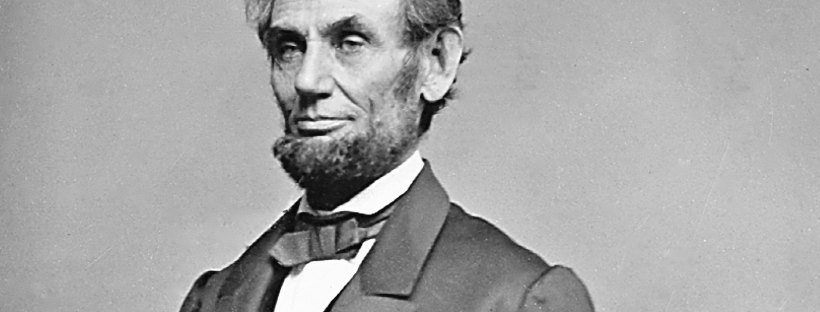
Abraham Lincoln was Elected as First Republican President On This Day in 1860

On November 6, 1860, Abraham Lincoln became the 16th president of the United States. He was the first Republican to win the presidency. He received only 40% of the popular vote, but still handily defeated the three other candidates: John C. Breckenridge (Southern Democrat), Stephen Douglas (Northern Democrat), and John Bell (Constitutional Union).

Lincoln’s victory signaled the secession of Southern states, which had publicly threatened secession if Republicans gained the White House. By the time of Lincoln’s inauguration on March 4, 1861, 7 states had seceded, and the Confederate States of America had been formally established. A month later, the Civil War began when Confederate forces opened fire on Fort Sumter in South Carolina.

This was the Republican Party Platform in 1860

Resolved, That we, the delegated representatives of the Republican electors of the United States in Convention assembled, in discharge of the duty we owe to our constituents and our country, unite in the following declarations:

1. That the history of the nation during the last four years, has fully established the propriety and necessity of the organization and perpetuation of the Republican party, and that the causes which called it into existence are permanent in their nature, and now, more than ever before, demand its peaceful and constitutional triumph.

2. That the maintenance of the principles promulgated in the Declaration of Independence and embodied in the Federal Constitution, “That all men are created equal; that they are endowed by their Creator with certain inalienable rights; that among these are life, liberty and the pursuit of happiness; that to secure these rights, governments are instituted among men, deriving their just powers from the consent of the governed,” is essential to the preservation of our Republican institutions; and that the Federal Constitution, the Rights of the States, and the Union of the States must and shall be preserved.

3. That to the Union of the States this nation owes its unprecedented increase in population, its surprising development of material resources, its rapid augmentation of wealth, its happiness at home and its honor abroad; and we hold in abhorrence all schemes for disunion, come from whatever source they may. And we congratulate the country that no Republican member of Congress has uttered or countenanced the threats of disunion so often made by Democratic members, without rebuke and with applause from their political associates; and we denounce those threats of disunion, in case of a popular overthrow of their ascendency as denying the vital principles of a free government, and as an avowal of contemplated treason, which it is the imperative duty of an indignant people sternly to rebuke and forever silence.

4. That the maintenance inviolate of the rights of the states, and especially the right of each state to order and control its own domestic institutions according to its own judgment exclusively, is essential to that balance of powers on which the perfection and endurance of our political fabric depends; and we denounce the lawless invasion by armed force of the soil of any state or territory, no matter under what pretext, as among the gravest of crimes.

5. That the present Democratic Administration has far exceeded our worst apprehensions, in its measureless subserviency to the exactions of a sectional interest, as especially evinced in its desperate exertions to force the infamous Lecompton Constitution upon the protesting people of Kansas; in construing the personal relations between master and servant to involve an unqualified property in persons; in its attempted enforcement everywhere, on land and sea, through the intervention of Congress and of the Federal Courts of the extreme pretensions of a purely local interest; and in its general and unvarying abuse of the power intrusted to it by a confiding people.

6. That the people justly view with alarm the reckless extravagance which pervades every department of the Federal Government; that a return to rigid economy and accountability is indispensable to arrest the systematic plunder of the public treasury by favored partisans; while the recent startling developments of frauds and corruptions at the Federal metropolis, show that an entire change of administration is imperatively demanded.

7. That the new dogma that the Constitution, of its own force, carries slavery into any or all of the territories of the United States, is a dangerous political heresy, at variance with the explicit provisions of that instrument itself, with contemporaneous exposition, and with legislative and judicial precedent; is revolutionary in its tendency, and subversive of the peace and harmony of the country.

8. That the normal condition of all the territory of the United States is that of freedom: That, as our Republican fathers, when they had abolished slavery in all our national territory, ordained that “no persons should be deprived of life, liberty or property without due process of law,” it becomes our duty, by legislation, whenever such legislation is necessary, to maintain this provision of the Constitution against all attempts to violate it; and we deny the authority of Congress, of a territorial legislature, or of any individuals, to give legal existence to slavery in any territory of the United States.

9. That we brand the recent reopening of the African slave trade, under the cover of our national flag, aided by perversions of judicial power, as a crime against humanity and a burning shame to our country and age; and we call upon Congress to take prompt and efficient measures for the total and final suppression of that execrable traffic

10. That in the recent vetoes, by their Federal Governors, of the acts of the legislatures of Kansas and Nebraska, prohibiting slavery in those territories, we find a practical illustration of the boasted Democratic principle of Non-Intervention and Popular Sovereignty, embodied in the Kansas-Nebraska Bill, and a demonstration of the deception and fraud involved therein.

11. That Kansas should, of right, be immediately admitted as a state under the Constitution recently formed and adopted by her people, and accepted by the House of Representatives.

12. That, while providing revenue for the support of the general government by duties upon imports, sound policy requires such an adjustment of these imports as to encourage the development of the industrial interests of the whole country; and we commend that policy of national exchanges, which secures to the workingmen liberal wages, to agriculture remunerative prices, to mechanics and manufacturers an adequate reward for their skill, labor, and enterprise, and to the nation commercial prosperity and independence.

13. That we protest against any sale or alienation to others of the public lands held by actual settlers, and against any view of the free-homestead policy which regards the settlers as paupers or suppliants for public bounty; and we demand the passage by Congress of the complete and satisfactory homestead measure which has already passed the House.

14. That the Republican party is opposed to any change in our naturalization laws or any state legislation by which the rights of citizens hitherto accorded to immigrants from foreign lands shall be abridged or impaired; and in favor of giving a full and efficient protection to the rights of all classes of citizens, whether native or naturalized, both at home and abroad.

15. That appropriations by Congress for river and harbor improvements of a national character, required for the accommodation and security of an existing commerce, are authorized by the Constitution, and justified by the obligation of Government to protect the lives and property of its citizens.

16. That a railroad to the Pacific Ocean is imperatively demanded by the interests of the whole country; that the federal government ought to render immediate and efficient aid in its construction; and that, as preliminary thereto, a daily overland mail should be promptly established.

17. Finally, having thus set forth our distinctive principles and views, we invite the co-operation of all citizens, however differing on other questions, who substantially agree with us in their affirmance and support.


On the eve of an election that has bitterly divided this country, I am reminded of this passage from Lincoln’s first inaugural address –

We are not enemies, but friends. We must not be enemies. Though passion may have strained, it must not break our bonds of affection. The mystic chords of memory, stretching from every battle-field, and patriot grave, to every living heart and hearth-stone, all over this broad land, will yet swell the chorus of the Union, when again touched, as surely they will be, by the better angels of our nature.


Reflecting on our Nation’s History on the 8th Anniversary of Barack Obama’s Election as America’s First Black President

On November 4, 2008, then-Senator Barack Obama of Illinois defeated Senator John McCain of Arizona to become the 44th president of the United States, and the first African American to serve as president.

Whatever your views of his policies or 8-year presidency, it is worth taking note of this historic moment in our nation’s history.

At the time of our nation’s founding, there were about a half million African slaves in the United States, primarily in the south. Many of our nation’s founders – including Thomas Jefferson, George Washington, and James Madison – owned slaves. Though it’s also worth noting that many others – including John Jay, Benjamin Rush, Alexander Hamilton, and John Adams—did not.

The 1787 federal Constitution, while never mentioning the words slavery or slave, contains three key compromises on enumeration (three-fifths clause), slave trade, and fugitive slaves. Those clauses are as follows –

Three Fifths Clause 

“Representatives and direct Taxes shall be apportioned among the several States which may be included within this Union, according to their respective Numbers, which shall be determined by adding to the whole Number of free Persons, including those bound to Service for a Term of Years, and excluding Indians not taxed, three fifths of all other Persons.”

Slave Trade Clause 

“The Migration or Importation of such Persons as any of the States now existing shall think proper to admit, shall not be prohibited by the Congress prior to the Year one thousand eight hundred and eight, but a Tax or duty may be imposed on such Importation, not exceeding ten dollars for each Person.”

Fugitive Slave Clause

“No Person held to Service or Labour in one State, under the Laws thereof, escaping into another, shall, in Consequence of any Law or Regulation therein, be discharged from such Service or Labour, but shall be delivered up on Claim of the Party to whom such Service or Labour may be due.”

Over 600,000 Americans died during our nation’s bloody civil war, fought, in part, over the issue of slavery.

The 13th Amendment formally abolished slavery when it was ratified in 1865. The Amendment reads –

SECTION 1

Neither slavery nor involuntary servitude, except as a punishment for crime whereof the party shall have been duly convicted, shall exist within the United States, or any place subject to their jurisdiction.

SECTION 2

Congress shall have power to enforce this article by appropriate legislation.

The 14th Amendment, ratified in 1868, granted citizenship rights to former slaves and promised “equal protections of the laws.” The Amendment reads in relevant part –

SECTION 1

All persons born or naturalized in the United States, and subject to the jurisdiction thereof, are citizens of the United States and of the State wherein they reside. No State shall make or enforce any law which shall abridge the privileges or immunities of citizens of the United States; nor shall any State deprive any person of life, liberty, or property, without due process of law; nor deny to any person within its jurisdiction the equal protection of the laws.

The Fifteenth Amendment, ratified in 1870, extended the franchise to black men. The amendment reads –

SECTION 1

The right of citizens of the United States to vote shall not be denied or abridged by the United States or by any State on account of race, color, or previous condition of servitude.

SECTION 2

The Congress shall have the power to enforce this article by appropriate legislation.

After Reconstruction ended, the era of Jim Crow began. It would take until the Civil Rights Movement of the 1960s and 70s for African Americans to receive more robust protection for their civil rights. The struggle for racial equality and civil rights continues to this day.

I was on the National Mall (with a group of mainly Republicans, it should be noted) the day President Obama was inaugurated in 2009. At that moment, at least amongst the group of thoughtful patriotic Americans I was with, politics didn’t matter. We were witnessing history and a moment that made all of us reflect on the words in our Constitution’s preamble – “We the People of the United States, in Order to form a more perfect Union…”

DC Residents Cast First Presidential Votes On This Day in 1964

On November 3, 1964, residents of the District of Columbia cast their ballots in a presidential election for the first time.

The 23rd Amendment, ratified in March 1961, gave citizens of the nation’s capital the right to vote for president and vice president. The amendment reads –

SECTION 1

The District constituting the seat of Government of the United States shall appoint in such manner as Congress may direct:

A number of electors of President and Vice President equal to the whole number of Senators and Representatives in Congress to which the District would be entitled if it were a State, but in no event more than the least populous State; they shall be in addition to those appointed by the States, but they shall be considered, for the purposes of the election of President and Vice President, to be electors appointed by a State; and they shall meet in the District and perform such duties as provided by the twelfth article of amendment.

SECTION 2

The Congress shall have power to enforce this article by appropriate legislation.

Washington, DC has three electoral votes, but only one non-voting delegates in the House of Representatives. The Washington D.C., Statehood Referendum is on the ballot this year.

State Ballot Measures in 2016

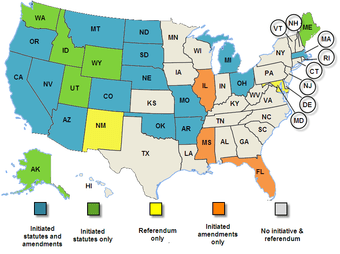
According to Ballotpedia, an online encyclopedia of information about politics at all levels of government, in November, there are 154 statewide ballot measures in 35 state. (If you include measures voted on before the November 8 election, that number goes up to 162). 71 of these ballot measures were put on the ballot via citizen initiative rather than by vote of the state legislature.

Measures on the 2016 statewide ballots include the following issues area (many of which are controversial) –

(1) Marijuana 

(2) Gun Control

(3) Minimum Wage

(4) California will vote on a statewide plastic bag ban

(5) Maine will vote on an initiative for a new system of voting

So what are ballot initiatives and referenda and whose uses them?

According to the National Council of State Legislatures, an initiative is

a process that enables citizens to bypass their state legislature by placing proposed statutes and, in some states, constitutional amendments on the ballot. The first state to adopt the initiative was South Dakota in 1898. Since then, 23 other states have included the initiative process in their constitutions, the most recent being Mississippi in 1992. That makes a total of 24 states with an initiative process.

There are both direct and indirect initiative processes. In a direct initiative process, qualifying proposals go directly on the ballot. In an indirect system, the initiative is first submitted to the state legislatures who may act on the proposal. Depending on the state, the initiative question will go on the ballot if the state legislature rejects the proposal, submits a different one, or takes no action. In some states, the legislature may also submit a competing measure that will appear on the ballot alongside the original ballot proposal. States with an indirect process include: Maine, Massachusetts, Michigan, Mississippi, Nevada and Ohio. In Utah and Washington, there are processes in place for either a direct or indirect ballot initiative process.

A referendum, on the other hand,

is a general term which refers to a measure that appears on the ballot. There are two primary types of referenda: the legislative referendum, whereby the Legislature refers a measure to the voters for their approval, and the popular referendum, a measure that appears on the ballot as a result of a voter petition drive.

What are the differences between legislative and popular referenda?

Legislatures are often required to refer certain measures to the ballot for voter approval. For instance, changes to the state constitution must be approved by voters before they can take effect. Many state legislatures are also required by their state constitutions to refer bond measures and tax changes to the voters. Although this is not always the case, legislative referenda tend to be less controversial than citizen initiatives, are more often approved by voters than citizen initiatives, and often receive higher vote thresholds. Legislative referenda may appear on the ballot in all 50 states.

The popular referendum is a device which allows voters to approve or repeal an act of the Legislature. If the Legislature passes a law that voters do not approve of, they may gather signatures to demand a popular vote on the law. Generally, there is a 90-day period after the law is passed during which the petitioning must take place. Once enough signatures are gathered and verified, the new law appears on the ballot for a popular vote. During the time between passage and the popular vote, the law may not take effect. If voters approve of the law, it takes effect as scheduled. If voters reject the law, it is voided and does not take effect. 24 states have the popular referendum. Most of them are also initiative states.

The map below, provided by Ballotpedia, shows which states use ballot initiatives and referenda.

340px-us_map_ir

You can learn more about the history of initiatives and referenda in the United States here.

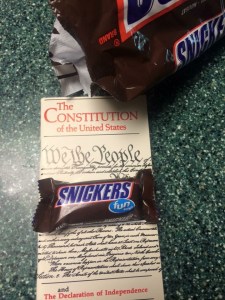
My Halloween Tradition: Candy and (Pocket) Constitutions


image1-9

Every year on Halloween I hand out pocket Constitutions (usually with a small sweet treat attached) to trick-or-treaters who visit my home.

Inevitably, some of these youngsters ask me: “What is this?” My reply is always the same, “A republic, if you can keep it.”

This year, pocket Constitutions were, for a time, the number two bestseller on Amazon.

So why do I engage in this tradition?

Because in my world every day is Constitution Day! Through my work as Executive Director of ConSource, I have the opportunity to connect citizens of all ages to our nation’s rich constitutional history.

Plus, I’d ask – is there really any treat sweeter than freedom? I think not! Why not use Halloween as an opportunity to demonstrate this to our nation’s young people?

Happy Birthday John Adams!

John Adams was born on October, 30, 1735.  Adams enrolled in Harvard University at age 16 and went on to teach school children and study law. Adams was instrumental in laying the foundation for the American Revolution. In 1783, he brokered the peace treaty between America and Britain that ended the American Revolution. Adams served as the nation’s first Vice President and second President.

Benjamin Rush wrote of Adams in 1776: “This illustrious patriot has not his superior, scarcely his equal for abilities and virtue on the whole of the continent of America.”

Sadly, Adams many accomplishments during the Revolutionary period are clouded by his signing of the Alien and Sedition Acts of 1798.

In honor of his birthday and contributions to the United States, I thought I’d spotlight some of my favorite quotes from Adams –

(1) “The Science of Government it is my Duty to study, more than all other Studies Sciences: the Art of Legislation and Administration and Negotiation, ought to take Place, indeed to exclude in a manner all other Arts. I must study Politicks and War that my sons may have liberty to study Painting and Poetry Mathematicks and Philosophy. My sons ought to study Mathematicks and Philosophy, Geography, natural History, Naval Architecture, navigation, Commerce and Agriculture, in order to give their Children a right to study Painting, Poetry, Musick, Architecture, Statuary, Tapestry and Porcelaine.”

(2) “Facts are stubborn things; and whatever may be our wishes, our inclinations, or the dictates of our passion, they cannot alter the state of facts and evidence.”

(3) “Thirteen governments thus founded on the natural authority of people alone, without a pretence of miracle or mystery, and which are destined to spread over the northern part of that whole quarter of the globe, are a great point gained in favor of the rights of mankind.”

(4) “But a Constitution of Government once changed from Freedom, can never be restored. Liberty once lost is lost forever.”

(5) “Posterity, you will never know how much it cost the present Generation to preserve your Freedom. I hope you will make good use of it. If you do not, I shall repent in Heaven, that I ever took half the Pains to preserve it.”

(6) “The Second Day of July 1776, will be the most memorable Epocha, in the History of America. I am apt to believe that it will be celebrated, by succeeding Generations, as the great anniversary Festival. It ought to be commemorated, as the Day of Deliverance by solemn Acts of Devotion to God Almighty. It ought to be solemnized with Pomp and Parade, with Shews, Games, Sports, Guns, Bells, Bonfires and Illuminations from one End of this Continent to the other from this Time forward forever more.

You will think me transported with Enthusiasm but I am not. — I am well aware of the Toil and Blood and Treasure, that it will cost Us to maintain this Declaration, and support and defend these States. — Yet through all the Gloom I can see the Rays of ravishing Light and Glory. I can see that the End is more than worth all the Means. And that Posterity will tryumph in that Days Transaction, even altho We should rue it, which I trust in God We shall not.”

(7) “It should be your care, therefore, and mine, to elevate the minds of our children and exalt their courage; to accelerate and animate their industry and activity; to excite in them an habitual contempt of meanness, abhorrence of injustice and inhumanity, and an ambition to excel in every capacity, faculty, and virtue. If we suffer their minds to grovel and creep in infancy, they will grovel all their lives.”

(8) “The preservation of the means of knowledge among the lowest ranks is of more importance to the public than all the property of all the rich men in the country.”

(9) “Children should be educated and instructed in the principles of freedom.”

(10) “The die was now cast; I had passed the Rubicon. Sink or swim, live or die, survive or perish with my country, was my unalterable determination.”

(11) “[L]iberty must at all hazards be supported. We have a right to it, derived from our Marker. But if we had not, our fathers have earned and bought it for us, at the expense of their estates, their pleasure, and their blood.”

(12) “There must be a positive Passion for the public good, the public Interest, Honour, Power and Glory, established in the Minds of the People, or there can be no Republican Government, nor any real Liberty: and this public Passion must be Superiour to all private Passions. Men must be ready, they must pride themselves, and be happy to sacrifice their private Pleasures, Passions and Interests, nay, their private Friendships and dearest Connections, when they stand in Competition with the Rights of Society.”

Book Spotlight: Alexander Hamilton: From Obscurity to Greatness

John Kaminski, founder and director of The Center for the Study of the American Constitution at the University of Wisconsin-Madison and director and co-editor of The Documentary History of the Ratification of the Constitution series, has a new book out on Alexander Hamilton.

In “Alexander Hamilton: From Obscurity to Greatness,” Kaminski brings Hamilton to life by publishing the words of not only Alexander Hamilton but also his contemporaries. The quotations in this volume were taken from the letters of the Founder, journals, diaries, newspaper essays, and speeches.

A few quotes I’d like to spotlight from the book –

(1) President George Washington to Alexander Hamilton, 2 February 1795 – “In every relation, which you have borne to me, I have found that my confidence in your talents, exertions and integrity, has been well placed. I the more freely render this testimony of my approbation, because I speak from opportunities of information which cannot deceive me, and which furnish satisfactory proof of your title to public regard.”

(2) John Adams to Abigail Adams, 9 January 1797 – “Hamilton I know to be a proud Spirited, conceited, aspiring Mortal always pretending to Morality, with as debauched Morals as old Franklin who is more his Model than any one I know. As great an Hypocrite as nay in the U.S. His Intrigues in the Election I despise. That he has Talents I admit. But I dread none of them. I shall take no notice of his Puppyhood but retain the same Opinion of him I always had and maintain the Same Conduct towards him I always did, that is keep him at a distance.”

(3) The Federalist No. 34, 5 January 1788 – “We must bear in mind, that we are not to confine our view to the present period, but to look forward to remote futurity. Constitutions of civil Government are not to be framed upon a calculation of exigencies; but upon a combination of these, with the probable exigencies of ages, according to the natural and tried course of human affairs. Nothing therefore can be more fallacious, than to infer the extent of any power, property to be lodged in the National Government, from an estimate of its immediate necessities. There ought to be a capacity to provide for future contingencies, as they may happen; and, as these are illimitable in their nature, it is impossible safely to limit that capacity.”

(4) Caesar No. II, 17 October 1787 – “There are always men in society of some talents, but more ambition, in quest of that which it would be impossible for them to obtain in any other way than by working on the passions and prejudices of the less discerning classes of citizens and yeomanry. — It is the plan of men of this stamp to frighten the people with ideal bugbears, in order to mould them to their own purposes. The unceasing cry of these designing croakers is, my friends, your liberty is invaded! Have you thrown off the yoke of one tyrant, to invest yourselves with that of another! Have you fought, bled, and conquered, for such a change! If you have – go – retire into silent obscurity, and kiss the rod that scourges you.”

(5) The Federalist No. 15, 1 December 1787 – “The best oracle of wisdom, experience.”

(6) The Federalist No. 30, 1 January 1788 – “In disquisition of every kind there are certain primary truths or first principles upon which all subsequent reasonings must depend. These contain an internal evidence, which antecedent to all reflection or combination commands the assent of the mind.”

I highly recommend that any fans of Hamilton, his eponymous Broadway show, or the Founders generally pick up this book! It’s available for purchase via Amazon.com here.