George Washington on “the insidious wiles of foreign influence.”

With recent explosive reports that the Central Intelligence Agency (CIA) found that Russia tried to influence the 2016 presidential election, I thought I’d call attention to something George Washington warned the nation about in his 1796 Farewell Address

“Against the insidious wiles of foreign influence (I conjure you to believe me, fellow-citizens) the jealousy of a free people ought to be constantly awake, since history and experience prove that foreign influence is one of the most baneful foes of republican government.”

Further investigation is clearly required to determine the full extent to which Russia interfered with the 2016 election. What I will say, though, is that American citizens ought to continue to carefully follow this story and, in the words of Washington “be constantly awake” to “the insidious wiles of foreign influences.”

Wyoming Passes First Law Granting Women the Right to Vote On This Day in 1869

The Wyoming territorial legislature passed the first woman’s suffrage law on December 10, 1869, and women voted in the state for the first time in 1870. The legislation extended suffrage to “every woman of the age of twenty-one years, residing in this Territory.”

At the time, there was no organized suffrage movement in the Wyoming territory. William Bright, who was persuaded by his wife that all citizens should have the right to vote, sponsored a bill to extend the franchise to women.

Bright’s colleagues in the territorial legislature had a variety of reasons for voting in favor his bill – some were motivated by a sense of fairness, others, unfortunately, viewed it as an opportunity to counteract the voting rights of newly enfranchised African American men, and for still others it was a way to gain publicity and persuade more pioneers to settle in the western territory.

Regardless of the motivation of the various territorial legislators, once Wyoming women got the right to vote, the state kept up its tradition of being a first for women. Wyoming went on to become the first state or territory with female jurors, female justices of the peace, and, in 1924, it became the first state to elect a female governor (Nellie Tayloe Ross).

Before Wyoming entered the union in 1890, it passed a new state constitution in 1889, guaranteeing women the right to vote. When the U.S. Congress threatened to withhold statehood over the issue, Wyoming officials responded that the territory would rather remain a territory for 100 years than join the union without women’s suffrage. Congress ultimately relented.

Note: Although, Wyoming is the first state with a law and then state constitution explicitly guaranteeing women the right to vote, women first voted in the New Jersey under its 1776 Constitution, which vaguely stated that “all inhabitants” of the state could vote. Women voted in New Jersey until 1807 when the state legislature passed a law limiting suffrage to free white males.


On This Day in 1863, Lincoln Issues Proclamation of Amnesty and Reconstruction

On December 8, 1863, President Abraham Lincoln offers his conciliatory plan for reunification of theUnited States with his Proclamation of Amnesty and Reconstruction. The Proclamation reads –

WHEREAS, in and by the Constitution of the United States, it is provided that the President “shall have power to grant reprieves and pardons for offences against the United States, except in cases of impeachment;” and

Whereas, a rebellion now exists whereby the loyal state governments of several states have for a long time been subverted, and many persons have committed, and are now guilty of, treason against the United States; and

Whereas, with reference to said rebellion and treason, laws have been enacted by congress, declaring forfeitures and confiscation of property and liberation of slaves, all upon terms and conditions therein stated, and also declaring that the President was thereby authorized at any time thereafter, by proclamation, to extend to persons who may have participated in the existing rebellion, in any state or part thereof, pardon and amnesty, with such exceptions and at such times and on such conditions as he may deem expedient for the public welfare; and

Whereas, the congressional declaration for limited and conditional pardon accords with well-established judicial exposition of the pardoning power; and

Whereas, with reference to said rebellion, the President of the United States has issued several proclamations, with provisions in regard to the liberation of slaves; and

Whereas, it is now desired by some persons heretofore engaged in said rebellion to resume their allegiance to the United States, and to reinaugurate loyal state governments within and for their respective states: Therefore–

I, ABRAHAM LINCOLN, President of the United States, do proclaim, declare, and make known to all persons who have, directly or by implication, participated in the existing rebellion, except as hereinafter excepted, that a full pardon is hereby granted to them and each of them, with restoration of all rights of property, except as to slaves, and in property cases where rights of third parties shall have intervened, and upon the condition that every such person shall take and subscribe an oath, and thenceforward keep and maintain said oath inviolate; and which oath shall be registered for permanent preservation, and shall be of the tenor and effect following, to wit:–

“I,                 , do solemnly swear, in presence of Almighty God, that I will henceforth faithfully support, protect, and defend the Constitution of the United States and the Union of the States thereunder; and that I will, in like manner, abide by and faithfully support all acts of congress passed during the existing rebellion with reference to slaves, so long and so far as not repealed, modified, or held void by congress, or by decision of the supreme court; and that I will, in like manner, abide by and faithfully support all proclamations of the President made during the existing rebellion having reference to slaves, so long and so far as not modified or declared void by decision of the supreme court. So help me God.”

The persons excepted from the benefits of the foregoing provisions are all who are, or shall have been, civil or diplomatic officers or agents of the so-called Confederate government; all who have left judicial stations under the United States to aid the rebellion; all who are, or shall have been, military or naval officers of said so-called Confederate government above the rank of colonel in the army or of lieutenant in the navy; all who left seats in the United States congress to aid the rebellion; all who resigned commissions in the army or navy of the United States and afterwards aided the rebellion; and all who have engaged in any way in treating colored persons, or white persons in charge of such, otherwise than lawfully as prisoners of war, and which persons may have been found in the United States service as soldiers, seamen, or in any other capacity.

And I do further proclaim, declare, and make known that whenever, in any of the States of Arkansas, Texas, Louisiana, Mississippi, Tennessee, Alabama, Georgia, Florida, South Carolina, and North Carolina, a number of persons, not less than one tenth in number of the votes cast in such state at the presidential election of the year of our Lord one thousand eight hundred and sixty, each having taken the oath aforesaid, and not having since violated it, and being a qualified voter by the election law of the state existing immediately before the so-called act of secession, and excluding all others, shall reëstablish a state government which shall be republican, and in nowise contravening said oath, such shall be recognized as the true government of the state, and the state shall receive thereunder the benefits of the constitutional provision which declares that “the United States shall guaranty to every state in this Union a republican form of government, and shall protect each of them against invasion; and on application of the legislature, or the executive, (when the legislature cannot be convened,) against domestic violence.”

And I do further proclaim, declare, and make known that any provision which may be adopted by such state government in relation to the freed people of such state, which shall recognize and declare their permanent freedom, provide for their education, and which may yet be consistent as a temporary arrangement with their present condition as a laboring, landless, and homeless class, will not be objected to by the National Executive.

And it is suggested as not improper that, in constructing a loyal state government in any state, the name of the state, the boundary, the subdivisions, the constitution, and the general code of laws, as before the rebellion, be maintained, subject only to the modifications made necessary by the conditions hereinbefore stated, and such others, if any, not contravening said conditions, and which may be deemed expedient by those framing the new state government.

To avoid misunderstanding, it may be proper to say that this proclamation, so far as it relates to state governments, has no reference to states wherein loyal state governments have all the while been maintained. And, for the same reason, it may be proper to further say, that whether members sent to congress from any state shall be admitted to seats constitutionally rests exclusively with the respective houses, and not to any extent with the Executive. And still further, that this proclamation is intended to present the people of the states wherein the national authority has been suspended, and loyal state governments have been subverted, a mode in and by which the national authority and loyal state governments may be reëstablished within said states, or in any of them; and while the mode presented is the best the Executive can suggest, with his present impressions, it must not be understood that no other possible mode would be acceptable.

Given under my hand at the city of Washington the eighth day of December, A.D. one thousand eight hundred and sixty-three, and of the Independence of the United States of America the eighty-eighth.

ABRAHAM LINCOLN.

The proclamation was issued with the hopes of expediting the Reconstruction process. By this time during the Civil War, much of the Confederate states were under federal control. Lincoln’s plan proposed that if 10% of a state’s voting population swore allegiance to the United States and approved emancipation, then Reconstruction of the government could begin in that state.

Lincoln declared that all those who opposed the Union – with the exception of those who ranked above Colonel in the Army or Lieutenant in the Navy, as well as traitors to the Union – would be pardoned and have their property rights (except for slaves) restored, on the condition that they swore this oath of allegiance:

“I,                 , do solemnly swear, in presence of Almighty God, that I will henceforth faithfully support, protect, and defend the Constitution of the United States and the Union of the States thereunder; and that I will, in like manner, abide by and faithfully support all acts of congress passed during the existing rebellion with reference to slaves, so long and so far as not repealed, modified, or held void by congress, or by decision of the supreme court; and that I will, in like manner, abide by and faithfully support all proclamations of the President made during the existing rebellion having reference to slaves, so long and so far as not modified or declared void by decision of the supreme court. So help me God.”

The radical Republicans in Congress wanted a much harsher process for ex-Confederates and wanted a guarantee for the civil rights of freedmen before Reconstruction was to begin in a state. Lincoln noted in his proclamation that “while the mode presented is the best the Executive can suggest, with his present impressions, it must not be understood that no other possible mode would be acceptable.” While his proclamation was to start the process of Reconstruction, he suggests with the language above that he is open to other policies proposed by Congress.

As we know Lincoln never gets to complete his presidential reconstruction, because he is assassinated in April 1865. In 1866, Congressional Republicans seize control of Reconstruction from President Johnson. Under congressional reconstruction,

Congress denied representatives from the former Confederate states their Congressional seats, passed the Civil Rights Act of 1866, and wrote the 14th Amendment to the Constitution, extending citizenship rights to African Americans and guaranteeing them equal protection of the laws. The 14th Amendment also reduced representation in Congress of any southern state that deprived African Americans of the vote. In 1870, the country went even further by ratifying the Fifteenth Amendment, which gave voting rights to black men.

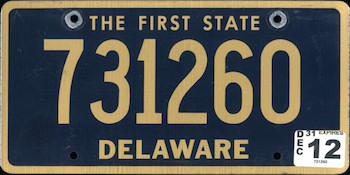
On This Day in 1787, Delaware Becomes the First State to Ratify the U.S. Constitution


delaware-license

On December 7,  1787, Delaware becomes the first state to ratify the Constitution, doing so by a unanimous vote.

The Delaware Form of Ratification reads

We the deputies of the People of the Delaware State, in Convention met, having taken into our serious consideration the Fœderal Constitution proposed and agreed upon by the Deputies of the United States in a General Convention held at the City of Philadelphia on the seventeenth day of September in the year of our Lord one thousand seven hundred and eighty seven, Have approved, assented to, ratified, and confirmed, and by these Presents, Do, in virtue of the Power and Authority to us given for that purpose, for and in behalf of ourselves and our Constituents, fully, freely, and entirely approve of, assent to, ratify and confirm the said Constitution.
Done in Convention at Dover this seventh day of December in the year aforesaid, and in the year of the Independence of the United States of America the twelfth In Testimony whereof we have hereunto subscribed our Names-
SUSSEX COUNTY
John Ingram John Jones William Moore William Hall Thomas Laws Isaac Cooper Woodman Stockley John Laws Thomas Evans Israel Holland
KENT COUNTY
Nicholas Ridgely Richard Smith George Truitt Richard Bassett James Sykes Allen McLane Daniel Cummins senr.
Joseph Barker Edward White George Manlove
NEW CASTLE COUNTY
Jas. Latimer, President James Black Jno. James Gunning Bedford senr.
Kensey Johns Thomas Wattson Solomon Maxwell Nicholas Way Thomas Duff Gunng Bedford junr.
To all whom these Presents shall come Greeting, I Thomas Collins President of the Delaware State do hereby certify, that the above instrument of writing is a true copy of the original ratification of the Fœderal Constitution by the Convention of the Delaware State, which original ratification is now in my possession. In Testimony whereof I have caused the seal of the Delware State to be hereunto anexed.
Since 1933, the governors of Delaware have proclaimed December 7 as Delaware Day in honor of when Delaware became the first state to ratify the U.S. Constitution, thus making Delaware the first state in the new nation. Delaware also commemorates being the first state to ratify the U.S. Constitution with its license plates which read “The First State.”

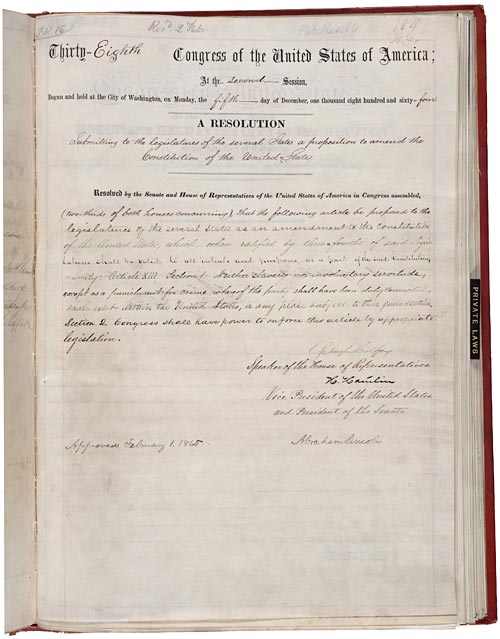
The 13th Amendment Was Ratified On This Day in 1865

doc_040_big-1

The 13th Amendment to the United States Constitution was ratified by the states on December 6, 1865. The amendment reads –

Section 1.
Neither slavery nor involuntary servitude, except as a punishment for crime whereof the party shall have been duly convicted, shall exist within the United States, or any place subject to their jurisdiction.

Section 2.
Congress shall have power to enforce this article by appropriate legislation

The 13th Amendment abolished both slavery and involuntary servitude throughout the nation and gave Congress the power to enforce the Amendment by “appropriate legislation.”

At the outset of the Civil War, few could imagine such a revolutionary amendment. In 1861, President Lincoln’s aim during the war was not to disrupt the South’s system of slavery, but instead to reunite the fractured nation.

According to Dr. Abigail Perkiss,

By the summer of 1862, though, with mounting deaths and desertions and declining enlistments of white soldiers, the President reconsidered his position.

By the end of the war, more than 186,000 black men had enlisted in Lincoln’s army, some 134,000 of whom came from slave-holding states.  Some were freed blacks who had made lives for themselves in the South, but many more were slaves who, when troops marched through the Confederacy, took it upon themselves to claim their freedom and sign up for the Union cause.

And as black soldiers entered the military, the relationship between the war and the institution of slavery became more intertwined.  As Lincoln saw it, with the inclusion of African-Americans in the conflict, the fight had become defined by the question of slavery.

On January 1, 1863, President Lincoln issued his Emancipation Proclamation, which read –

By the President of the United States of America:

A Proclamation.

Whereas, on the twentysecond day of September, in the year of our Lord one thousand eight hundred and sixty two, a proclamation was issued by the President of the United States, containing, among other things, the following, to wit:

“That on the first day of January, in the year of our Lord one thousand eight hundred and sixty-three, all persons held as slaves within any State or designated part of a State, the people whereof shall then be in rebellion against the United States, shall be then, thenceforward, and forever free; and the Executive Government of the United States, including the military and naval authority thereof, will recognize and maintain the freedom of such persons, and will do no act or acts to repress such persons, or any of them, in any efforts they may make for their actual freedom.

“That the Executive will, on the first day of January aforesaid, by proclamation, designate the States and parts of States, if any, in which the people thereof, respectively, shall then be in rebellion against the United States; and the fact that any State, or the people thereof, shall on that day be, in good faith, represented in the Congress of the United States by members chosen thereto at elections wherein a majority of the qualified voters of such State shall have participated, shall, in the absence of strong countervailing testimony, be deemed conclusive evidence that such State, and the people thereof, are not then in rebellion against the United States.”

Now, therefore I, Abraham Lincoln, President of the United States, by virtue of the power in me vested as Commander-in-Chief, of the Army and Navy of the United States in time of actual armed rebellion against the authority and government of the United States, and as a fit and necessary war measure for suppressing said rebellion, do, on this first day of January, in the year of our Lord one thousand eight hundred and sixty three, and in accordance with my purpose so to do publicly proclaimed for the full period of one hundred days, from the day first above mentioned, order and designate as the States and parts of States wherein the people thereof respectively, are this day in rebellion against the United States, the following, to wit:

Arkansas, Texas, Louisiana, (except the Parishes of St. Bernard, Plaquemines, Jefferson, St. Johns, St. Charles, St. James Ascension, Assumption, Terrebonne, Lafourche, St. Mary, St. Martin, and Orleans, including the City of New Orleans) Mississippi, Alabama, Florida, Georgia, South-Carolina, North-Carolina, and Virginia, (except the fortyeight counties designated as West Virginia, and also the counties of Berkley, Accomac, Northampton, Elizabeth-City, York, Princess Ann, and Norfolk, including the cities of Norfolk and Portsmouth[)], and which excepted parts, are for the present, left precisely as if this proclamation were not issued.

And by virtue of the power, and for the purpose aforesaid, I do order and declare that all persons held as slaves within said designated States, and parts of States, are, and henceforward shall be free; and that the Executive government of the United States, including the military and naval authorities thereof, will recognize and maintain the freedom of said persons.

And I hereby enjoin upon the people so declared to be free to abstain from all violence, unless in necessary self-defence; and I recommend to them that, in all cases when allowed, they labor faithfully for reasonable wages.

And I further declare and make known, that such persons of suitable condition, will be received into the armed service of the United States to garrison forts, positions, stations, and other places, and to man vessels of all sorts in said service.

And upon this act, sincerely believed to be an act of justice, warranted by the Constitution, upon military necessity, I invoke the considerate judgment of mankind, and the gracious favor of Almighty God.

In witness whereof, I have hereunto set my hand and caused the seal of the United States to be affixed.

Done at the City of Washington, this first day of January, in the year of our Lord one thousand eight hundred and sixty three, and of the Independence of the United States of America the eighty-seventh.

By the President: ABRAHAM LINCOLN

WILLIAM H. SEWARD, Secretary of State.

The proclamation was largely a military gesture, and it only freed slaves in the Confederacy, where Lincoln had no control. And yet, as historian Eric Foner describes, the symbolic proclamation had real effect –

“[N]ever before had so large a number of slaves been declared free. By making the army an agent of emancipation and wedding the goals of Union and abolition, it ensured that northern victory would produce a social transformation in the South and a redefinition of the place of blacks in American life.”

Nearly a year later, in mid-December 1863 Congressman James Ashley of Ohio introduced a bill supporting a federal prohibition on slavery. A month later, in January 1864, Missouri Senator John Henderson submitted a joint resolution for a constitutional amendment.

The Senate, dominated by Republicans, passed the amendment on April 3, 1864, but the amendment languished in the House of Representatives, where many Democrats rallied against the amendment for encroaching on the rights of the states. Because the amendment was not confined in its reach to the federal government, but instead extended to both the states and individual citizens, many Democrats feared it too greatly expanded the powers of the federal government.

The election of 1864 secured Republican majorities in both the House and Senate. And on January 31, 1865, the 13th amendment passed the House by a vote of 119 to 56, seven votes above the needed two-thirds majority vote for a constitutional amendment.

The amendment was then sent to the states for ratification and was ratified on December 6, 1865, when Georgia voted to ratify the Amendment.

And so today we mark the 151st anniversary of the formal abolition of slavery in the United States of America.
 

A Toast to the 21st Amendment, Ratified on December 5, 1933


Dec05LN-blog480.jpg


On December 5, 1933, national prohibition came to an end, when Utah became the 36th state to ratify the 21st Amendment to the U.S. Constitution. The 21st Amendment repealed the 18th Amendment, which went into effect nearly 14 years earlier.

The 18th Amendment reads –

SECTION 1

After one year from the ratification of this article the manufacture, sale, or transportation of intoxicating liquors within, the importation thereof into, or the exportation thereof from the United States and all territory subject to the jurisdiction thereof for beverage purposes is hereby prohibited.

SECTION 2

The Congress and the several States shall have concurrent power to enforce this article by appropriate legislation.

SECTION 3

This article shall be inoperative unless it shall have been ratified as an amendment to the Constitution by the legislatures of the several States, as provided in the Constitution, within seven years from the date of the submission hereof to the States by the Congress.

The 18th Amendment was adopted after a concerted campaign by the national temperance movement. The proponents of the national temperance movement believed that alcohol led to reckless and destructive behavior, and that prohibition would lead to reductions in crime – especially issues related to domestic violence – and would improve the health and welfare of all Americans.

It’s important to note that by 1830,

the average American over 15 years old consumed nearly seven gallons of pure alcohol a year – three times as much as we drink today – and alcohol abuse (primarily by men) was wreaking havoc on the lives of many, particularly in an age when women had few legal rights and were utterly dependent on their husbands for sustenance and support.

While prohibition did dramatically reduce alcohol consumption and alcohol-related deaths, it also gave rise to a large black market for alcohol and strengthened organized crime.

You can explore a Prohibition timeline provided by PBS here.

Prohibition came to an end when the 21st Amendment was ratified. The 21st Amendment reads –

SECTION 1

The eighteenth article of amendment to the Constitution of the United States is hereby repealed.

SECTION 2

The transportation or importation into any State, Territory, or Possession of the United States for delivery or use therein of intoxicating liquors, in violation of the laws thereof, is hereby prohibited.

SECTION 3

This article shall be inoperative unless it shall have been ratified as an amendment to the Constitution by conventions in the several States, as provided in the Constitution, within seven years from the date of the submission hereof to the States by the Congress.

The 21st Amendment returned regulation of alcohol to the states. Each state sets its own rules for the sale and importation of alcohol.

A federal law provides federal funds to states that prohibit the sale of alcohol to minors under the age of 21. As a result, all 50 states have set their minimum drinking age at 21. The rules regarding sale and importation of alcohol varies widely between states.


There’s Still Time to Register for the 5th Annual Harlan Institute – ConSource Virtual Supreme Court Competition for High School Students

High School teachers – there’s still time to register your students for the Harlan Institute – ConSource Virtual Supreme Court Competition. Additional information about the Competition is below –

The Harlan Institute and The Constitutional Sources Project (ConSource) announce their Fifth Annual Virtual Supreme Court competition. This competition offers teams of two high school students the opportunity to research cutting-edge constitutional law, write persuasive appellate briefs, argue against other students through video chats, and try to persuade a panel of esteemed attorneys during oral argument that their side is correct. This year the competition focuses on Trinity Lutheran Church v. Sarah Parker Pauley, exploring whether funding a playground associated with a Church violates the Establishment Clause of the First Amendment.

ConSource Executive Director Julie Silverbrook believes “the Virtual Supreme CourtCompetition is an excellent opportunity for high school students to develop core civic and constitutional literacy skills. Students are required to read the text of the Constitution, explore the history behind a contemporary constitutional dispute, and construct persuasive arguments. We know that experiences like theVirtual Supreme Court Competition leave a lifelong impression on participating students and encourages them to stay informed and engaged throughout their lives.”

Tanya Reyna, a winner of the 2016 Virtual Supreme Court Competition, noted that while her local community in Texas suffers from “an influx of drugs and criminals” and has dampened her views about the future of her community and the nation, her experience with the Virtual Supreme Court Competition “eased [her] apprehension [about the future].” She said that meeting “students, lawyers, professors, and judges” willing to take time out of their busy schedules “to inform younger generations of citizens about our legal system,” demonstrated to her that “as long as there are citizens like them, America will continue to hold a bright future.”

The members of the grand-prize winning team, the Solicitors General of FantasySCOTUS, will receive a free trip, including airfare and one night of hotel accommodations, to Washington, D.C. or New York City to attend the ConSource Constitution Day celebration in September 2017. Members of the runner-up team will each receive an iPad Mini. Members of the third and fourth place teams will each receive a $100 Amazon.com Gift card.

Screen shot 2016-10-02 at 10.51.13 PM.png


Josh Blackman, President of the Harlan Institute, champions theVirtual Supreme Court Competition, which provides an “unprecedented opportunity for high school students to engage in the highest level of appellate advocacy. They research the issues, write briefs, and make oral arguments before our judges. The strong caliber of the winning teams last year really impressed us. We can’t wait to see how the teams perform this year!”

Teachers interested in participating should sign up at HarlanInstitute.org, add an account, read the problem, and get started!

Please send any questions to info@harlaninstitute.orgor info@consource.org.

If you’re interested in supporting the Virtual Supreme Court Competition and the extraordinary students who participate across the country, please consider making a donation today!

You Can’t Defend What You Don’t Understand: A Plea for Support of Civics Education

There is an often-told story that at the end of the Constitutional Convention, Benjamin Franklin was approached by a woman who asked him what sort of government the delegates had created. Franklin famously replied, “A republic, if you can keep it.”

To keep it, we must teach it. You cannot defend what you do not understand. And so in order for citizens to defend the Constitution and the Bill of Rights, they must first understand it.

James Wilson, a founding father from Pennsylvania, once said that “[l]aw and liberty cannot rationally become the objects of our love, unless they first become the objects of our knowledge.”

And, yet, countless reports and studies confirm that American citizens of all ages lack a basic understanding of our nation’s history and form of government. A survey released last year by the Annenberg Public Policy Center at the University of Pennsylvania found that –

  • Only one in three Americans could name all three branches of the U.S. government, while just as many could not identify even one; and,
  • And about one in 10 Americans say the Bill of Rights includes the right to own a pet.

Additionally, across the nation, school boards and colleges and universities are cutting civics and history programs and young citizens are, as a result, losing the opportunity to study our nation’s Constitution and history. We are not only failing to teach our citizens about U.S. history and the Constitution in primary and secondary school, but also in college. The American Council of Trustees and Alumni found that only approximately 18.3% of colleges and universities require even a single foundational course in American government in history.

If you believe in defending the United States Constitution, then you also have to invest in civics education and constitutional literacy. You can help do this by investing in ConSource and other non-profits invested in promoting knowledge about the U.S. Constitution and our system of government.

New Resource for High School Teachers: Constitutional Convention Simulation

I’m presenting at the National Council for the Social Studies annual conference in Washington, DC this weekend on ConSource’s new Choosing to Make a Nation Curriculum project, and in particular our Constitutional Convention unit, which is now available for free download. More information about both is provided below. This is an outstanding resource for high school government and history teachers!

Choosing to Make a Nation: Interactive Lessons on the Revolution, Constitution, and Bill of Rights

The Choosing to Make a Nation Curriculum Project developed by award-winning author Ray Raphael is a student-centered, primary source-rich approach to teaching about American history and our nation‘s founding documents. The lesson plans in this curriculum are premised on the idea that history is the chronicle of choices made by actors/agents/protagonists in specific contexts. Students understand choices – they make them all the time. These lessons involve students by placing them in the shoes of historical people and asking: “What might you do in such instances?”

For these exercises to be historical (more than affirmations of individual whims), we needed to provide context: what was the issue, the problem to be solved? What were the existing realities/constraints that limited possibilities? With those in mind, what were the available options? For each option, how did people view the possibilities for a desired outcome? What were the potential dangers? When studying battles, we see how generals evaluate troop strengths, positioning, logistics, morale, and so on. In fact, all historical actors do this—not just leading political figures, but ordinary people and collective bodies. In Revolutionary times, people often made decisions in groups, both indoors (town meetings, caucuses, conventions, congresses) and “out-of-doors,” as they said at the times, informal gatherings that protested authority or enforced popular will. Individuals, forced to navigate the troubled waters of those days, also faced momentous decisions.

Our task is to introduce students to historical protagonists who confronted such choices. Points of decision create teachable moments. We help students imagine, from a distant time, the hopes of these people, but also their constraints. With these protagonists, students explore the available options. Having skin in the game, they will better understand why people acted as they did. They will think more deeply about the paths actually taken — how events ensued, the consequences of decisions, and the subsequent issues these created. By exercising individual and group decision-making skills within political contexts, they prepare for civic life.

The Constitutional Convention unit is now available for free download here.

Other units will be published online once completed, and include: The Road to Revolution; The Declaration of Independence, The Revolutionary War; Articles of Confederation and State Constitutions; Ratification of the Constitution; the Bill of Rights; and the Constitution in Action.

Constitutional Convention Simulation

Basic Structure for Choice-Centered Lessons

  • Formulate the problem, the issue at hand; define the players; provide context.
  • Outline and discuss the available options.
  • Individuals or groups make and reveal their choices.
  • Presentation of the historical outcome: the choice actually made by the players – using historical documents whenever possible.
  • Analysis of the historical outcome.

Infrastructure for the Constitutional Convention Simulation

  • The eight lessons can be used individually or as a unit. In either case, here are the basic rules of operation.
  • Assign each student to a state delegation in 1787 Federal Convention in Philadelphia. You can also allow students to choose their states. Students should sit with their fellow state delegates.
  • Break groups, called “discussion and debate” (D&D) groups will be comprised of several state delegations from diverse regions: lower South, upper South, mid-Atlantic, New England. These should be small enough to allow each student to participate. The number of state delegations represented in each group will vary according to class size.
  • Each time students meet in their D&D groups, they should be reminded that these are for deliberations only. The groups do not have to come to any agreements. Students will not be casting votes in these groups.
  • Students will vote by state delegation – one vote for each state delegation, just as it was at the Federal Convention of 1787. If delegates of any state are evenly divided on an issue, they report “divided” as their state’s vote.

If you plan to teach each lesson in the unit, here is the suggested order:

  1. Reform or Revolution? (one-day and two-day options)
  2. Composition of Congress (one-day and two-day options)
  3. Creating an Executive (one-day and two-day options)
  4. Should Judges Judge Laws? (one-day lesson)
  5. Fine Tuning the Balance of Powers (one-day and two-day options)
  6. Slavery at the Constitutional Convention (two-day lesson)
  7. Amendments and Ratification (one-day and two-day options)
  8. To Sign or Not To Sign
    1. Option A: The Historical Constitution (one-day lesson)
    2. Option B: The Student-Generated Constitution (one-day lesson)


The Oldest Synagogue in America was Dedicated On This Day in 1763

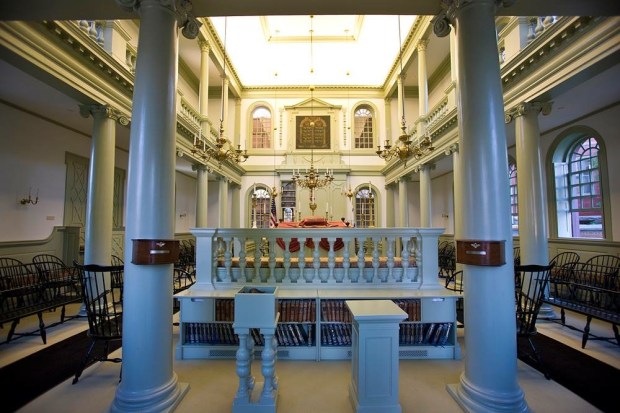
Touro Synagogue was dedicated on December 2, 1763 in Newport, Rhode Island. It is the oldest synagogue building in the United States.

img_1749

The congregation was founded in 1658 by the descendants of Jewish families who fled the Inquisitions in Spain and Portugal and who themselves left the Caribbean seeking the greater religious tolerance that Rhode Island offered.

One of my favorite historical documents is the letter George Washington wrote to the congregants of Touro Synagogue in August of 1790 discussing religious liberty and toleration.

“Gentlemen:

While I received with much satisfaction your address replete with expressions of esteem, I rejoice in the opportunity of assuring you that I shall always retain grateful remembrance of the cordial welcome I experienced on my visit to Newport from all classes of citizens.

The reflection on the days of difficulty and danger which are past is rendered the more sweet from a consciousness that they are succeeded by days of uncommon prosperity and security.

If we have wisdom to make the best use of the advantages with which we are now favored, we cannot fail, under the just administration of a good government, to become a great and happy people.

The citizens of the United States of America have a right to applaud themselves for having given to mankind examples of an enlarged and liberal policy—a policy worthy of imitation. All possess alike liberty of conscience and immunities of citizenship.

It is now no more that toleration is spoken of as if it were the indulgence of one class of people that another enjoyed the exercise of their inherent natural rights, for, happily, the Government of the United States, which gives to bigotry no sanction, to persecution no assistance, requires only that they who live under its protection should demean themselves as good citizens in giving it on all occasions their effectual support.

It would be inconsistent with the frankness of my character not to avow that I am pleased with your favorable opinion of my administration and fervent wishes for my felicity.

May the children of the stock of Abraham who dwell in this land continue to merit and enjoy the good will of the other inhabitants—while every one shall sit in safety under his own vine and fig tree and there shall be none to make him afraid.

May the father of all mercies scatter light, and not darkness, upon our paths, and make us all in our several vocations useful here, and in His own due time and way everlastingly happy.

G. Washington”