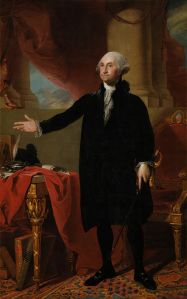
On This Day in 1790, George Washington delivers the first State of the Union Address

639px-gilbert_stuart_-_george_washington_-_google_art_project


Article II, Section 3 of the United States Constitution states –

[The President] shall from time to time give to the Congress Information of the State of the Union….

On January 8, 1790, President George Washington delivered the first State of the Union address to Congress assembled in New York City. The full text of Washington’s address is below. I’d like to call attention here to my favorite passage –

Nor am I less persuaded that you will agree with me in opinion that there is nothing which can better deserve your patronage than the promotion of science and literature. Knowledge is in every country the surest basis of public happiness. In one in which the measures of government receive their impressions so immediately from the sense of the community as in ours it is proportionably essential.

To the security of a free constitution it contributes in various ways – by convincing those who are intrusted with the public administration that every valuable end of government is best answered by the enlightened confidence of the people, and by teaching the people themselves to know and to value their own rights; to discern and provide against invasions of them; to distinguish between oppression and the necessary exercise of lawful authority; between burthens proceeding from a disregard to their convenience and those resulting from the inevitable exigencies of society; to discriminate the spirit of liberty from that of licentiousness – cherishing the first, avoiding the last – and uniting a speedy but temperate vigilance against encroachments, with an inviolable respect to the laws.

Washington’s First Annual State of the Union Address

Fellow-Citizens of the Senate and House of Representatives:

I embrace with great satisfaction the opportunity which now presents itself of congratulating you on the present favorable prospects of our public affairs. The recent accession of the important state of North Carolina to the Constitution of the United States (of which official information has been received), the rising credit and respectability of our country, the general and increasing good will toward the government of the Union, and the concord, peace, and plenty with which we are blessed are circumstances auspicious in an eminent degree to our national prosperity.

In resuming your consultations for the general good you can not but derive encouragement from the reflection that the measures of the last session have been as satisfactory to your constituents as the novelty and difficulty of the work allowed you to hope. Still further to realize their expectations and to secure the blessings which a gracious Providence has placed within our reach will in the course of the present important session call for the cool and deliberate exertion of your patriotism, firmness, and wisdom.

Among the many interesting objects which will engage your attention that of providing for the common defense will merit particular regard. To be prepared for war is one of the most effectual means of preserving peace.

A free people ought not only to be armed, but disciplined; to which end a uniform and well-digested plan is requisite; and their safety and interest require that they should promote such manufactories as tend to render them independent of others for essential, particularly military, supplies.

The proper establishment of the troops which may be deemed indispensable will be entitled to mature consideration. In the arrangements which may be made respecting it it will be of importance to conciliate the comfortable support of the officers and soldiers with a due regard to economy.

There was reason to hope that the pacific measures adopted with regard to certain hostile tribes of Indians would have relieved the inhabitants of our southern and western frontiers from their depredations, but you will perceive from the information contained in the papers which I shall direct to be laid before you (comprehending a communication from the Commonwealth of Virginia) that we ought to be prepared to afford protection to those parts of the Union, and, if necessary, to punish aggressors.

The interests of the United States require that our intercourse with other nations should be facilitated by such provisions as will enable me to fulfill my duty in that respect in the manner which circumstances may render most conducive to the public good, and to this end that the compensation to be made to the persons who may be employed should, according to the nature of their appointments, be defined by law, and a competent fund designated for defraying the expenses incident to the conduct of foreign affairs.

Various considerations also render it expedient that the terms on which foreigners may be admitted to the rights of citizens should be speedily ascertained by a uniform rule of naturalization.

Uniformity in the currency, weights, and measures of the United States is an object of great importance, and will, I am persuaded, be duly attended to.

The advancement of agriculture, commerce, and manufactures by all proper means will not, I trust, need recommendation; but I can not forbear intimating to you the expediency of giving effectual encouragement as well to the introduction of new and useful inventions from abroad as to the exertions of skill and genius in producing them at home, and of facilitating the intercourse between the distant parts of our country by a due attention to the post-office and post-roads.

Nor am I less persuaded that you will agree with me in opinion that there is nothing which can better deserve your patronage than the promotion of science and literature. Knowledge is in every country the surest basis of public happiness. In one in which the measures of government receive their impressions so immediately from the sense of the community as in ours it is proportionably essential.

To the security of a free constitution it contributes in various ways – by convincing those who are intrusted with the public administration that every valuable end of government is best answered by the enlightened confidence of the people, and by teaching the people themselves to know and to value their own rights; to discern and provide against invasions of them; to distinguish between oppression and the necessary exercise of lawful authority; between burthens proceeding from a disregard to their convenience and those resulting from the inevitable exigencies of society; to discriminate the spirit of liberty from that of licentiousness – cherishing the first, avoiding the last – and uniting a speedy but temperate vigilance against encroachments, with an inviolable respect to the laws.

Whether this desirable object will be best promoted by affording aids to seminaries of learning already established, by the institution of a national university, or by any other expedients will be well worthy of a place in the deliberations of the legislature.

Gentlemen of the House of Representatives:

I saw with peculiar pleasure at the close of the last session the resolution entered into by you expressive of your opinion that an adequate provision for the support of the public credit is a matter of high importance to the national honor and prosperity. In this sentiment I entirely concur; and to a perfect confidence in your best endeavors to devise such a provision as will be truly with the end I add an equal reliance on the cheerful cooperation of the other branch of the legislature.

It would be superfluous to specify inducements to a measure in which the character and interests of the United States are so obviously so deeply concerned, and which has received so explicit a sanction from your declaration.

Gentlemen of the Senate and House of Representatives:

I have directed the proper officers to lay before you, respectively, such papers and estimates as regard the affairs particularly recommended to your consideration, and necessary to convey to you that information of the state of the Union which it is my duty to afford.

The welfare of our country is the great object to which our cares and efforts ought to be directed, and I shall derive great satisfaction from a cooperation with you in the pleasing though arduous task of insuring to our fellow citizens the blessings which they have a right to expect from a free, efficient, and equal government.
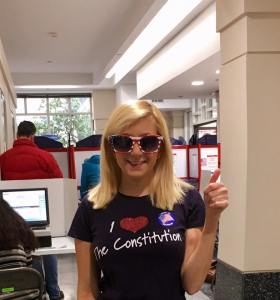
The Blizzard of 1996 and How I Became the Constitution Lady


14915660_10103837765274474_8437099042512736976_n

As I overlook the snow falling in Washington this afternoon, I am reminded of January 7, 1996, when a blizzard dumped 20 to 30 inches of snow in my hometown in Bucks County, Pennsylvania and forced the closure of schools and businesses for several days.

I was in fourth grade at the time, and my mother, in an attempt to keep her three kids occupied while also preventing learning loss, decided to give me and my two siblings encyclopedia assignments. The assignment was simple enough. She assigned us a letter, and we were to pick a topic in the the print encyclopedia (yes, we still had print encyclopedias in the 1990s) with that letter and prepare a short presentation.

She assigned me the letter “C.” I serendipitously opened the encyclopedia to the entry on the Constitution and prepared my oral report. As luck would have it, when I returned to school, my teacher discussed the three branches of the United States Government. Since I was now a self-proclaimed constitutional scholar (at the tender age of 8), I was able to correctly answer all of the questions he posed to the class. As a stereotypical A-type personality, I decided then and there that I was on to something with this whole Constitution thing, and, perhaps, I should keep studying it and, therefore, answering questions correctly.

From that moment at the age of 8 onward, I developed a deep abiding love and appreciation for the Constitution. I would go on to study student speech issues in middle and high school, and even started a “Constitution club” in high school, where students could gather after school to discuss pressing constitutional issues.

In college, I was awarded a research fellowship to study the development of the “clear and present danger” standard. As part of my research, I traveled around the country and met with a number of leading first amendment scholars. This experience demonstrated to me the importance of discussing the contours of constitutional rights.

In law school, I created Constitutional Conversations, an award-winning, non-partisan, community-based education program in partnership with the Institute of Bill of Rights Law, The Colonial Williamsburg Foundation, and the Williamsburg Regional Library system. The program sent law students into the community to educate citizens about their constitutional rights and responsibilities. The program continues at William & Mary Law School today.

Today, I have the privilege of serving as executive director of The Constitutional Sources Project. Through my work over the last 5 years, I have had the opportunity to teach thousands of citizens about the Constitution and our nation’s constitutional history.

Several years ago, a young woman emailed me about the Constitution for a paper she was writing in her middle school class. In that email, she wrote “Dear Constitution Lady…” I think the name fits, and so have adopted it as my unofficial title as I travel the country discussing the Constitution.

I can thank the Blizzard of 1996, my mother, and a print encyclopedia for setting me on this lifelong journey. I believe my work has never been more important than it is now, and look forward to continuing to promote constitutional literacy in the years ahead!


On This Day in 1789, the First U.S. Presidential Election is Held

639px-gilbert_stuart_-_george_washington_-_google_art_project


On this day in 1789, America’s first presidential election under the federal Constitution is held. Voters cast ballots to choose state electors. At the time, only white men who owned property were allowed to vote. George Washington was elected and sworn into office on April 30, 1789.

The electoral votes in the 1789 election were as follows –

(1) George Washington of Virginia: 69

(2) John Adams of Massachusetts: 34 (prior to the ratification of the 12th amendment, the candidate who received the most electoral votes became president, while the candidate who won the second most became vice president).

(3) John Jay of New York: 9

(4) Robert Hanson Harrison of Maryland: 6

(5) John Rutledge of South Carolina: 6

(6) Samuel Huntington of Connecticut: 2

(7) John Milton of Georgia: 2

(8) James Armstrong of Pennsylvania: 1

(9) Benjamin Lincoln of Massachusetts: 1

(10) Edward Telfair of Georgia: 1

4 electors failed to cast their ballots, and only 10 out of 13 states participated in the election. North Carolina and Rhode Island had not yet ratified the Constitution and were, therefore, ineligible to participate. New York also did not participate because a deadlock in the state legislature led to a failure to appoint its allotment of 8 electors.

A Modern Tradition for Congress: The Annual Reading of the Constitution on the House Floor

Under Article VI, Clause 3 of the Constitution, members of Congress must swear an oath to support the Constitution –

“The Senators and Representatives before mentioned, and the Members of the several State Legislatures, and all executive and judicial Officers, both of the United States and of the several States, shall be bound by Oath or Affirmation, to support this Constitution[.]

Title 5, Section 3331 of the United States Code sets out the oath each member of Congress must swear or affirm to before taking office –

“I, AB, do solemnly swear (or affirm) that I will support and defend the Constitution of the United States against all enemies, foreign and domestic; that I will bear true faith and allegiance to the same; that I take this obligation freely, without any mental reservation or purpose of evasion, and that I will well and faithfully discharge the duties of the office on which I am about to enter. So help me God.”

In 2011, for the first time in the history of the House of Representatives, the full text of the Constitution was read aloud. The annual tradition has continued ever since. You can watch this year’s annual reading here: https://www.c-span.org/video/?420996-1/us-house-members-read-us-constitution.

This is an excellent opportunity to take a moment to read the Constitution and explore its history. I invite you to do both by visiting http://www.ConSource.org


Civic Engagement Should be Your New Year’s Resolution

ceheader2


On Monday evening, during a closed-room vote, the House GOP proposed major changes to the independent Office of Congressional Ethics (OCE). Under the new rules, the OCE would no longer operate as an independent agency.  It would, instead, answer to the House Ethics Committee, putting Congress in charge of policing itself.

The public outcry was swift and effective. According to the Washington Post’s Robert Costa, members of Congress cited constituent concerns as the most important factor in their decision to sideline the proposed changes to OCE.

screen-shot-2017-01-04-at-12-02-43-pm

This moment serves as a reminder of the power of civic engagement. As I’ve said here before – being a citizen does not begin and end on Election Day. It’s a 365-day-a-year job.

Make civic engagement your New Year’s resolution. Here are some ways you can get and stay involved throughout the year –

(1) Vote regularly at the local, state, and national level and help persuade others to vote, as well

(2) Contact elected officials

(3) Volunteer in your local community or for an organization with statewide or national goals

(4) Active membership in a group or association

(5) Giving or fundraising for a cause that’s important to you.

(6) Displaying buttons, signs, and stickers related to an issue important to you, your local community or the nation.

(7) Sign online or written petitions

(8) Write a letter to the editor

(9) Boycott or protest

(10) Discuss issues that matter to you with people in your network.

(11) MAKE SURE YOU STAY INFORMED! Information is the key to meaningful engagement!


The Separation of Church and State: Jefferson Sends His Famous Letter to the Danbury Baptists On This Day in 1802

Jefferson’s letter reads –

To messers. Nehemiah Dodge, Ephraim Robbins, & Stephen S. Nelson, a committee of the Danbury Baptist association in the state of Connecticut.

Gentlemen

The affectionate sentiments of esteem and approbation which you are so good as to express towards me, on behalf of the Danbury Baptist association, give me the highest satisfaction. my duties dictate a faithful and zealous pursuit of the interests of my constituents, & in proportion as they are persuaded of my fidelity to those duties, the discharge of them becomes more and more pleasing.

Believing with you that religion is a matter which lies solely between Man & his God, that he owes account to none other for his faith or his worship, that the legitimate powers of government reach actions only, & not opinions, I contemplate with sovereign reverence that act of the whole American people which declared that their legislature should “make no law respecting an establishment of religion, or prohibiting the free exercise thereof,” thus building a wall of separation between Church & State. Adhering to this expression of the supreme will of the nation in behalf of the rights of conscience, I shall see with sincere satisfaction the progress of those sentiments which tend to restore to man all his natural rights, convinced he has no natural right in opposition to his social duties.

I reciprocate your kind prayers for the protection & blessing of the common father and creator of man, and tender you for yourselves & your religious association, assurances of my high respect & esteem.

Th Jefferson
Jan. 1. 1802.

Jefferson’s letter was in response to this letter from the Danbury Baptist Association received in October 1801 –

SIR,

Among the many millions in America and Europe who rejoice in your Election to office; we embrace the first opportunity which we have enjoy’d in our collective capacity, since your Inauguration, to express our great satisfaction, in your appointment to the chief Magistracy in the United States: And though our mode of expression may be less courtly and pompious than what many others clothe their addresses with, we beg you, Sir to believe, that none are more sincere.

Our Sentiments are uniformly on the side of Religious Liberty—That Religion is at all times and places a Matter between God and Individuals—That no man aught to suffer in Name, person or effects on account of his religious Opinions—That the legetimate Power of civil Goverment extends no further than to punish the man who works ill to his neighbour: But Sir, our constitution of goverment is not specific. Our antient charter, together with the Laws made coincident therewith, were adopted as the Basis of our goverment, At the time of our revolution; and such had been our Laws & usages, & such still are; that religion is consider’d as the first object of Legislation; & therefore what religious privileges we enjoy (as a minor part of the State) we enjoy as favors granted, and not as inalienable rights: and these favors we receive at the expence of such degrading acknowledgements as are inconsistant with the rights of freemen. It is not to be wondred at therefore; if those, who seek after power & gain under the pretence of goverment & Religion should reproach their fellow men—should reproach their chief Magistrate, as an enemy of religion Law & good order because he will not, dares not assume the prerogative of Jehovah and make Laws to govern the Kingdom of Christ.

Sir, we are sensible that the President of the united States, is not the national Legislator, & also sensible that the national goverment cannot destroy the Laws of each State; but our hopes are strong that the sentiments of our beloved President, which have had such genial Effect already, like the radiant beams of the Sun, will shine & prevail through all these States and all the world till Hierarchy and tyranny be destroyed from the Earth. Sir when we reflect on your past services, and see a glow of philanthropy and good will shining forth in a course of more than thirty years we have reason to believe that America’s God has raised you up to fill the chair of State out of that good will which he bears to the Millions which you preside over. May God strengthen you for the arduous task which providence & the voice of the people have cal’d you to sustain and support you in your Administration against all the predetermin’d opposition of those who wish to rise to wealth & importance on the poverty and subjection of the people

And may the Lord preserve you safe from every evil and bring you at last to his Heavenly Kingdom throug Jesus Christ our Glorious Mediator.

Signed in behalf of the Association

NEHH. DODGE

EPHM. ROBBINS                          The Committee

STEPHEN S NELSON

Abraham Lincoln Issues the Emancipation Proclamation On This Day in 1863


On January 1, 1863, Abraham Lincoln issued his emancipation proclamation, reading –

By the President of the United States of America:

A Proclamation.

Whereas, on the twenty second day of September, in the year of our Lord one thousand eight hundred and sixty two, a proclamation was issued by the President of the United States, containing, among other things, the following, to wit:

“That on the first day of January, in the year of our Lord one thousand eight hundred and sixty-three, all persons held as slaves within any State or designated part of a State, the people whereof shall then be in rebellion against the United States, shall be then, thenceforward, and forever free; and the Executive Government of the United States, including the military and naval authority thereof, will recognize and maintain the freedom of such persons, and will do no act or acts to repress such persons, or any of them, in any efforts they may make for their actual freedom.

“That the Executive will, on the first day of January aforesaid, by proclamation, designate the States and parts of States, if any, in which the people thereof, respectively, shall then be in rebellion against the United States; and the fact that any State, or the people thereof, shall on that day be, in good faith, represented in the Congress of the United States by members chosen thereto at elections wherein a majority of the qualified voters of such State shall have participated, shall, in the absence of strong countervailing testimony, be deemed conclusive evidence that such State, and the people thereof, are not then in rebellion against the United States.”

Now, therefore I, Abraham Lincoln, President of the United States, by virtue of the power in me vested as Commander-in-Chief, of the Army and Navy of the United States in time of actual armed rebellion against the authority and government of the United States, and as a fit and necessary war measure for suppressing said rebellion, do, on this first day of January, in the year of our Lord one thousand eight hundred and sixty three, and in accordance with my purpose so to do publicly proclaimed for the full period of one hundred days, from the day first above mentioned, order and designate as the States and parts of States wherein the people thereof respectively, are this day in rebellion against the United States, the following, to wit:

Arkansas, Texas, Louisiana, (except the Parishes of St. Bernard, Plaquemines, Jefferson, St. Johns, St. Charles, St. James Ascension, Assumption, Terrebonne, Lafourche, St. Mary, St. Martin, and Orleans, including the City of New Orleans) Mississippi, Alabama, Florida, Georgia, South-Carolina, North-Carolina, and Virginia, (except the fortyeight counties designated as West Virginia, and also the counties of Berkley, Accomac, Northampton, Elizabeth-City, York, Princess Ann, and Norfolk, including the cities of Norfolk and Portsmouth[)], and which excepted parts, are for the present, left precisely as if this proclamation were not issued.

And by virtue of the power, and for the purpose aforesaid, I do order and declare that all persons held as slaves within said designated States, and parts of States, are, and henceforward shall be free; and that the Executive government of the United States, including the military and naval authorities thereof, will recognize and maintain the freedom of said persons.

And I hereby enjoin upon the people so declared to be free to abstain from all violence, unless in necessary self-defence; and I recommend to them that, in all cases when allowed, they labor faithfully for reasonable wages.

And I further declare and make known, that such persons of suitable condition, will be received into the armed service of the United States to garrison forts, positions, stations, and other places, and to man vessels of all sorts in said service.

And upon this act, sincerely believed to be an act of justice, warranted by the Constitution, upon military necessity, I invoke the considerate judgment of mankind, and the gracious favor of Almighty God.

In witness whereof, I have hereunto set my hand and caused the seal of the United States to be affixed.

Done at the City of Washington, this first day of January, in the year of our Lord one thousand eight hundred and sixty three, and of the Independence of the United States of America the eighty-seventh.

By the President: ABRAHAM LINCOLN

WILLIAM H. SEWARD, Secretary of State.

It’s important to note that the Emancipation Proclamation was limited in many ways. It applied only to states that had seceded from the Union, and did not apply to to slaves in border states that remained loyal to the Union. It also expressly exempted part of the Confederacy that were already under Union control. Further, the freedom it promised depended upon the Union’s military victory.

It’s argued that –

When reunification was the sole goal of the North, the Confederates could be viewed by foreigners as freedom fighters being held against their will by the Union. But after the Emancipation Proclamation, the Southern cause was now the defense of slavery. The proclamation was a shrewd maneuver by Lincoln to brand the Confederate States as a slave nation and render foreign aid impossible.

Upon signing the Proclamation, Lincoln said “I never felt more certain that I was doing right, than I do in signing this paper.”


There’s Still Time to Support the Constitution in 2016!

George Washington famously said in 1795 “[T]he Constitution is the guide, that I will never abandon.”

You cannot be guided by what you do not understand. And so in order for the Constitution to be the guide our citizens will never abandon, they must first understand it.

ConSource is devoted to ensuring that American citizens of all ages understand the Constitution.

Your year-end contribution will support:

We hope you will consider donating today. Every dollar donated to ConSource helps us ensure that Americans of all ages, in the words of Noah Webster, value “the principles of virtue and of liberty,” and that we “inspire them with just and liberal ideas of government and with an inviolable attachment to their own country.”

Thank You and Happy New Year!


The Election of 1800: A Divisive Election, the Electoral College and the Peaceful Transition of Power

As we approach the inauguration of President-elect Trump, I thought it might be useful to consider our nation’s first divisive election –

The presidential election of 1800 between incumbent John Adams and his vice president Thomas Jefferson was a divisive and hard-fought election for both candidates. Federalists attacked Jefferson as an un-Christian deist, whose sympathy for the French and their revolution threatened to bring similar chaos to the United States. Democratic-Republicans attacked Adams and Federalists in Congress over the centralization of federal governmental power, and the Alien and Sedition Acts.

In the end, the Democratic-Republicans swept both houses of Congress. The decision in the Electoral College was much closer. Under the Constitution, vote for president and vice president were not listed on separate ballots. Although Jefferson and Adams were the primary opponents, Jefferson actually received the same number of electoral votes as his running mate, Aaron Burr. According to the Article II, Section 1 of the Constitution, if two candidates each received a majority of the electoral votes but are tied, the House of Representatives would determine which one would be president. Therefore, the decision rested with the House of Representatives, then still under Federalist control, where each state would cast a single vote.

Most Federalists preferred Aaron Burr. But, after 35 blocked ballots, Alexander Hamilton, a well-respected Federalist party leader, helped secure the presidency for Jefferson, viewing him as the lesser of two evils. As we know, Burr went on to fatally shoot Hamilton in their infamous duel.

With Jefferson’s election and the Federalist defeat in Congress, this was the first time government under the new Constitution would change party hands. It is significant that after such a divisive election, there was a peaceful transition of political power between the opposing parties. Jefferson appreciated this moment when in his inaugural address, he said “But every difference of opinion is not a difference of principle. We have called by different names brethren of the same principle. We are all Republicans, we are all Federalists.” You can read the full text of Jefferson’s first inaugural address here.

The tie vote between Jefferson and Burr in the Electoral College pointed to serious problems with the electoral system under the U.S. Constitution. In 1804, the 12th Amendment was passed and ratified to correct these problems by providing for separate Electoral College votes for President and Vice President.

This episode in our nation’s history can be used to encourage discussion of divisive elections, political parties, the Electoral College, and the peaceful transition of political power.

Christmas, Family Tradition, and the Annual Reenactment of Washington Crossing the Delaware River

During the holiday season, I traditionally return to my family home in historic Bucks County, Pennsylvania to celebrate with family and attend the annual reenactment of George Washington’s daring 1776 crossing of the Delaware River on Christmas Day. Washington and his men braved ice, sleet, and blinding snow to cross the river and achieve victory over the Hessian soldiers at Trenton. Washington’s bold victory reinvigorated the American people’s fight for independence.

The men and women who recreate Washington’s famous crossing take pains to preserve the integrity and accuracy of this famous military feat.  And, although, the actor interpreters do not always successfully cross the river (as rising tides and ice have prevented safe passage for many years), hundreds of patriotic citizens still gather to commemorate and relive a crucial moment in American history.

As we huddle together in the cold each year, I am reminded that there are many Americans who wish to meaningfully reconnect with and learn more about our nation’s history.

This is why I have devoted my career to connecting American citizens to our nation’s constitutional history. Learn more about my work at ConSource at http://www.ConSource.org.

You can watch a livestream of this year’s reenactment on noon ET on Christmas Day here: https://www.youtube.com/watch?v=RS2piSau56c