227 years ago, the U.S. Senate Confirmed the First U.S. Supreme Court Justices

On September 26, 1789, the U.S. Senate voted to confirm  John Jay, John Rutledge, William Cushing, John Blair, Robert Harrison, and James Wilson as the first justices of the United States Supreme Court.

John Jay was confirmed as the nation’s first Chief Justice. Jay served as a delegated to both the First and Second Continental Congresses, and was elected president of the Continental Congress in 1778. He also contributed five essays to The Federalist (now known as The Federalist Papers), and was a stronger supporter of the federal Constitution of 1787. After serving as Chief Justice for five years, Jay resigned from the Supreme Court on June 29, 1795, and became Governor of New York. He declined a second appointment as Chief Justice in 1800, and President John Adams then nominated John Marshall for the position.

001_jay

John Rutledge  was elected to the South Carolina Commons House of Assembly. In 1764, he was appointed Attorney General of South Carolina by the King’s Governor and served for ten months. Rutledge served as the youngest delegate to the Stamp Act Congress of 1765.He was a member South Carolina delegation to the Constitutional Convention in 1787 and served as a member of the South Carolina Ratification Convention the following year. After one year on the Supreme Court, Rutledge resigned in 1791 to become Chief Justice of South Carolina’s highest court. On August 12, 1795, President George Washington nominated Rutledge Chief Justice of the United States. He served in that position as a recess appointee for four months, but the Senate refused to confirm him.

002_rutledge

William Cushing served as Chief Justice of the Massachusetts Supreme Judicial Court from 1780 to 1789. He strongly supported ratification of the U.S. Constitution and served as Vice Chairman of the Massachusetts Ratification Convention. Cushing served on the Court for 20 years.

002_cushing

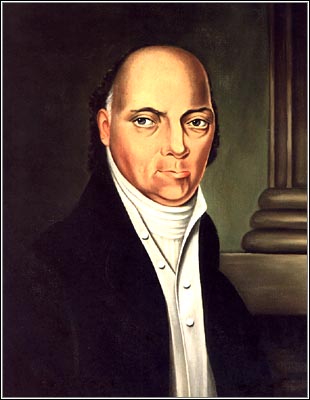
John Blair began his public service in 1766 as a member of the Virginia House of Burgesses. In 1770, he resigned from the House to become Clerk of the Governor’s Council. Blair was a delegate to the Virginia Convention of 1776, which drafted the State Constitution. Blair became a Judge of the Virginia General Court in 1777 and was elevated to Chief Judge in 1779. From 1780 to 1789, he served as a Judge of the First Virginia Court of Appeals. Blair was a delegate to the Federal Constitutional Convention of 1787 and was one of three Virginia delegates to sign the Constitution. He was also a delegate to the Virginia Ratification Convention of 1788. He served on the Court for only 5 years, and resigned due to the rigors of circuit riding and ill health.
003_blair

Robert Harrison served as the Chief Justice of the General Court of Maryland from 1781 to 1789.Harrison, ultimately, declined to serve as an associate justice, citing health reasons. The seat eventually went to James Iredell.

robert_hanson_harrison

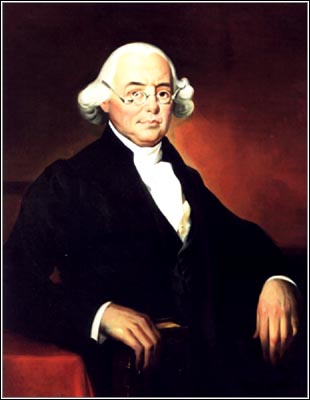
James Wilson was elected a delegate to the First Continental Congress in 1775 and was a signer of the Declaration of Independence. He also served as a delegate to the Second Continental Congress. As a delegate to the Constitutional Convention in Philadelphia in 1787, Wilson was a member of the committee that produced the first draft of the Constitution. He signed the finished document on September 17, 1787, and later served as a delegate to the Pennsylvania Ratification Convention. He served on the Court for eight years.
001_wilson

(Biographical information of the justices was provided by the Supreme Court Historical Society).

Presidential Debate Primer: Check out Washington Times Special Section on the President and the Constitution

In honor of Constitution Day this year, I took the lead on behalf of the National Constitutional Literacy Campaign on the publication of a Washington Times special section on the President and the Constitution. The special report includes articles from Senators Patrick Leahy and Mike Lee, among many others.

On the eve of tomorrow night’s presidential debate, I hope folks will consider reading, reflecting, and learning from the public officials, scholars and civic education advocates who submitted articles on this timely topic. It’s a great presidential debate primer.

The full special section is available in PDF form here.

Articles include:

Section 1: Citizens, Civic Knowledge, and Presidential Elections

(1) Julie Silverbrook, Why A Call for Civic Education and Constitutional Literacy?

(2) Julie Silverbrook, Student Competitions Spark Optimism, Civic Involvement

(3) Charles Quigley, Effective Civic Education Produces Informed Voters

(4) Dr. Michael Poliakoff, Civic Illiteracy and Civic Disempowerment

(5) Jeff Hymas, A Democratic or Republican Election? 

(6) Kyle Kondik, ‘Tyranny of the Swing States’?

(7) Meg Heubeck and Gerard Ferri, Get in the Game: Empowering America’s Next Generation to Vote

Section 2: Congress and the President

(1) Congressman George Nethercutt, Founders Intended ‘Tension’ In Co-Equal Branches

(2) Dr. Robert J. Spitzer, Political Gridlock, Past and Present

(3) Senator Patrick Leahy, Constitution Day: Protection Our Democracy

(4) Senator Mike Lee, The Battle to ‘Keep’ the American Republic

(5) Dr. Matthew Spalding, Congress and the New Imperial Presidency

Section 3: The Courts and the President

(1) Elizabeth Wydra, The President, the Constitution, and the Supreme Court

(2) Dr. Louis Fisher, How Courts Expand Presidential Power Beyond Constitutional Limits

(3) Ken Gormley, Presidents and the Supreme Court: Public Battles and Quiet Respect

Section 4: The Media and the President

(1) Julie Silverbrook, The Constitution on the Campaign Trail in 2016

(2) David Keene, the ‘Genius’ of the Constitution 

(3) Janine Turner and Andrew Langer, Is the Media Responsible for the Too-Power Presidency?

(4) Shoshana Weissman, How Social Media Gives Public Opinion Wings

Section 5: The Expansion of Presidential Authority

(1) Tim Donner, The Ever-Expanding Power of the Presidency

(2) Josh Blackman, Unteaching Professor Obama’s Constitutional Lessons

(3) Dr. Jason Stevens, Calvin Coolidge and the ‘two minds’ of the American Presidency

(4) Scott Michelman, Upholding the Right ‘To Be Let Alone’

227 Years Ago Congress Approved the Bill of Rights


bill_of_rights_630

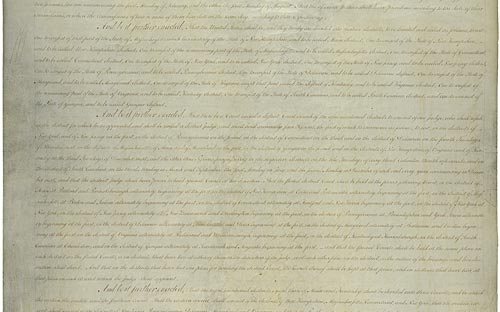
On September 25, 1789, Congress approved 12 amendments to the United States Constitution and sent them to the states for ratification. The 10 amendments that were ultimately ratified (on December 15, 1791) became known as the Bill of Rights.

Here are the 12 amendments sent to the states on September 25. You might be surprised by the issues that ranked first and second above our now First Amendment. The second amendment proposed in 1789, regarding congressional pay, was ratified nearly 203 years later in 1992 and is now the 27th amendment to the U.S. Constitution.

THE Conventions of a number of the States, having at the time of their adopting the Constitution, expressed a desire, in order to prevent misconstruction or abuse of its powers, that further declaratory and restrictive clauses should be added: And as extending the ground of public confidence in the Government, will best ensure the benificent ends of its institution
RESOLVED by the Senate and House of Representatives of the United States of America, in Congress assembled, two thirds of both Houses concurring, that the following Articles be proposed to the Legislatures of the several States, as amendments to the Constitution of the United States, all or any of which Articles, when ratified by three fourths of the said Legislatures, to be valid to all intents and purposes, as part of the said Constitution; vizt.
ARTICLES in addition to, and amendment of the Constitution of the United States of America, proposed by Congress, and ratified by the Legislatures of the several States, pursuant to the fifth Article of the original Constitution.

ARTICLE THE FIRST. After the first enumeration required by the first Article of the Constitution, there shall be one Representative for every thirty thousand, until the number shall amount to one hundred, after which, the proportion shall be so regulated by Congress, that there shall be not less than one hundred Representatives, nor less than one Representative for every forty thousand persons, until the number of Representatives shall amount to two hundred, after which the proportion shall be so regulated by Congress, that there shall not be less than two hundred Representatives, nor more than one Representative for every fifty thousand persons.

ARTICLE THE SECOND. No law, varying the compensation for the services of the Senators and Representatives, shall take effect, until an election of Representatives shall have intervened.

ARTICLE THE THIRD. Congress shall make no law respecting an establishment of religion, or prohibiting the free exercise thereof; or abridging the freedom of speech, or of the press, or the right of the people peaceably to assemble, and to petition the Government for a redress of grievances.

ARTICLE THE FOURTH. A well regulated militia, being necessary to the security of a free State, the right of the people to keep and bear arms, shall not be infringed.

ARTICLE THE FIFTH. No Soldier shall, in time of peace be quartered in any House, without the consent of the owner, nor in time of war, but in a manner to be prescribed by law.

ARTICLE THE SIXTH. The right of the people to be secure in their persons, houses, papers, and effects, against unreasonable searches and seizures, shall not be violated, and no warrants shall issue, but upon probable cause, supported by oath or affirmation, and particularly describing the place to be searched and the persons or things to be seized.

ARTICLE THE SEVENTH. No person shall be held to answer for a capital, or otherwise infamous crime, unless on a presentment or indictment of {a} Grand Jury, except in cases arising in the land or naval forces, or in the militia, when in actual service in time of war or public danger; nor shall any person be subject for the same offence to be twice put in jeopardy of life or limb; nor shall be compelled in any criminal case to be a witness against himself, nor be deprived of life, liberty, or property, without due process of law;nor shall private property be taken for public use, without just compensation.

ARTICLE THE EIGHTH. In all criminal prosecutions, the accused shall enjoy the right to a speedy and public trial, by an impartial jury of the State and district wherein the crime shall have been committed; which district shall have been previously ascertained by law, and to be informed of the nature and cause of the accusation; to be confronted with the witnesses against him; to have compulsory process for obtaining witnesses in his favor, and to have the assistance of counsel for his defence.

ARTICLE THE NINTH. In suits at common law, where the value in controversy shall exceed twenty dollars, the right of trial by jury shall be preserved, and no fact tried by a jury, shall be otherwise re-examined in any Court of the United States, than according to the rules of the common law.

ARTICLE THE TENTH. Excessive bail shall not be required, nor excessive fines imposed, nor cruel and unusual punishments inflicted.

ARTICLE THE ELEVENTH. The enumeration the Constitution, of certain rights, shall not be construed to deny or disparage others retained by the people.

ARTICLE THE TWELFTH. The powers not delegated to the United States by the Constitution, nor prohibited by it to the States, are reserved to the States respectively, or to the people.


You can explore the legislative history of the Bill of Rights in the ConSource digital library. 

100 years in the making, National Museum of African American History and Culture Opens on the National Mall

The National Museum of African American History and Culture opens today on the National Mall. It opens 100 years after the museum was first proposed and 13 years after it was authorized by Congress.

The museum’s website describes the NMAAHC as

[T]he only national museum devoted exclusively to the documentation of African American life, history, and culture. It was established by Act of Congress in 2003, following decades of efforts to promote and highlight the contributions of African Americans. To date, the museum has collected more than 36,000 artifacts. Nearly 100,000 individuals have become charter members of the museum.

The website goes on to spell out the four pillars on which the new museum is premised -It provides an opportunity for those who are interested in African American culture to explore and revel in this history through interactive exhibitions;

  1. It helps all Americans see how their stories, their histories, and their cultures are shaped and informed by global influences;

  2. It explores what it means to be an American and share how American values like resiliency, optimism, and spirituality are reflected in African American history and culture; and

  3. It serves as a place of collaboration that reaches beyond Washington to engage new audiences and to collaborate with the myriad of museums and educational institutions that have explored and preserved this important history well before this museum was created.

Congressman John Lewis, who was a driving force behind the museum, said “There were some who said it couldn’t happen, who said ‘you can’t do it’ but we did it. . . This place is more than a building. It is a dream come true.”

The museum opened with a series of celebrations and speeches (many still ongoing) from Chief Justice John Roberts (who serves as the chancellor of the Smithsonian Institution), President Barack Obama, former president George W. Bush (who signed the 2003 bill authorizing the museum), Oprah Winfrey, and many others.

Lonnie Bunch, the director of the NMAAHC, said of the museum that it will “not just tell of a people’s journey, but a nation’s story.” He went on to say, “There is nothing more powerful than a people, than a nation steeped in history. . . And nothing more noble than honoring all of our ancestors by remembering.”

President Obama, the nation’s first black president, said, “This national museum helps to tell a richer and fuller story of who we are. It helps us better understand the lives, yes, of the president but also the slave, the industrialist but also the porter, the keeper of the status quo but also the activist seeking to overthrow that status quo.” He went on to say, in imagining taking his grandchildren to the museum, that “[t]ogether we’ll learn about ourselves, as Americans.”

The museum now owns close to 37,000 artifacts. You can explore their collection online here.

Here are some interesting artifacts in the museum’s collection:

(1) Digital collection of manuscripts and images related to the Freedmen’s Bureau;

(2) Rosa Parks’ dress

(3) The pen used by Lyndon B. Johnson to sign the Voting Rights Act of 1965

(4) Program from the March on Washington (1963)

(5) Jim Crow-era Southern Railway car

(6) Nat Turner’s Bible

(7) Emmett Till’s casket


The 227th Anniversary of the Judiciary Act of 1789

Today marks the 227th anniversary of the Judiciary Act of 1789. The Judiciary Act of 1789, officially titled “An Act to establish the Judicial Courts of the United States,” was passed by Congress and signed by President George Washington on September 24, 1789.

Article III of the U.S. Constitution had only sketched out the nature of the federal judiciary in very general terms. This Act provided for its detailed organization.

 The judicial power of the United States, shall be vested in one Supreme Court, and in such inferior courts as the Congress may from time to time ordain and establish.

Acting on this authority, Congress created a three-part judiciary. The Supreme Court consisted of a Chief Justice and five associate justices (an even number for anyone who is counting). The same day that the Judiciary Act was passed and signed, President Washington nominated John Jay to preside as chief justice, and John Rutledge, James Wilson, John Blair, Robert Harrison, and William Cushing to be associate justices. Two days later, on September 26, all six appointments were confirmed by the U.S. Senate.

The middle tier of the judiciary was made up of federal circuit courts and served as the principal trial courts in the federal system. They also exercised limited appellate jurisdiction.

A federal judge was designated to preside over a United States district court in each state and in Kentucky and Maine, which were then part of other states. These courts heard admiralty and maritime cases, as well as other minor disputes.

During the debates over whether or not to ratify the Constitution, a number of citizens raised concerns about the federal judiciary encroaching on state courts and restricting civil liberties. The Judiciary Act of 1789 addressed these concerns by allowing state courts to exercise concurrent jurisdiction with federal courts in a number of matters. For example, Section 11 reads,

That the circuit courts shall have original cognizance, concurrent with the courts of the several States, of all suits of a civil nature at common law or in equity, where the matter in dispute exceeds, exclusive of costs, the sum or value of five hundred dollars, and the United States are plaintiffs, or petitioners; or an alien is a party, or the suit is between a citizen of the State where the suit is brought, and a citizen of another State. (emphasis added)

The debate over the Judiciary Act occurred at the same time that the Congress was considering amendments to the Constitution (these amendments would become the Bill of Rights). The Bill of Rights, ultimately, offered further assurance that the federal courts would respect both the states and traditional liberties of citizens such as the right to trial by jury.


PBS NewsHour and Microsoft Launch Website That Allows You to Watch Every Televised Presidential Debate

PBS NewsHour and Microsoft have partnered to put online every presidential debate since the first (and, perhaps, most famous) televised debate in U.S. history between John F. Kennedy and Richard Nixon. The debates, as well as some interesting and useful interactive and educational content are available at http://www.WatchTheDebates.org.

This is a great resource for history and social studies teachers, and all citizens who are interested in catching up on the history of televised presidential debates before Monday’s match-up between Hillary Clinton and Donald Trump. Definitely recommend checking out the website.

Constitution Swag: Why I Love It and Where to Get it!


1921026_10102357710905294_1281333742_o

I get a lot of compliments on my Constitution swag. I have a Constitution necklace, bracelet, scarf, shoes with both the Constitution and Declaration hand-painted on them, multiple totes, and a variety of Constitution t-shirts.

Why do I love to wear what I teach? It gets attention.

When I wear my “I ❤ The Constitution” t-shirt to the grocery store or out to lunch or dinner, I’m always surprised by the number of people who come up to me to say “Me too!” or “That’s awesome!”. Never one to waste an opportunity to promote constitutional literacy, I usually share my card and invite these folks to visit http://www.ConSource.org (my non-profit’s website) to learn more about the Constitution and our nation’s history.

Here are some of my favorite places to buy Constitution Swag online:

(1) Etsy

(2) The Constitution Store (yes, this exists and is run by the US Capitol Historical Society)

(3) The National Archives Store Online

I also recommend checking out the gift shops at the National Constitution Center in Philadelphia, PA, and the Newseum in Washington, DC. I usually pick up fun Constitution-themed gear and gifts whenever I visit either museum.


A Simulated Article V Convention is happening in Williamsburg, Va, This Week. What is An Article V Convention?

This week in Williamsburg, Va, Citizens for Self-Government is hosting a simulated Convention of the States to propose amendments to the Constitution under Article V of the Constitution. Their mission is –

[T]o urge and empower state legislators to call a convention of states. The delegates at such a convention would have the power to propose amendments to the Constitution that would curb the abuses of the federal government. Article V of the Constitution gives them this power; the COS Project will give them an avenue through which they can use it.

Article V of the Constitution includes a provision that “on application of two-thirds of the several States,” Congress “shall call a convention for proposing Amendments.”

Supporters of Article V conventions have mounted vigorous (and yet unsuccessful) campaigns in the past (reaching a peak of interest in the 1960s through the early 1980s) on a range of issues including: restrictions on abortion, apportionment of state legislatures, and a federal balanced budget. None of these campaigns attained the necessary applications from two-thirds of the states. Indeed, we have never adopted a Constitutional amendment using an Article V convention. All 27 of the Constitution’s amendments adopted since 1787 came from Congress and not from applications of the states (Article V provides that whenever two-thirds of both Houses of Congress “shall deem it necessary, shall propose Amendments to [the] Constitution.”)

In recent years, in response to congressional deadlock, there has been a renewed interest in Article V conventions from groups across the political spectrum. Groups on the right like Citizens for Self-Government are interested in the balanced budget requirement and restrictions on federal governmental authority. On the left, there is an interest in calling an Article V convention to repeal the Supreme Court’s decision in Citizen United.

So why haven’t Article V conventions worked in the past?

The main reason is the Constitution’s requirement that a super-majority of two-thirds of the state legislatures must apply for an Article V Convention.

But there’s a reason for this stringent requirement, as James Madison discussed in The Federalist No. 43.

“It guards equally against that extreme facility which would render the Constitution too mutable; and that extreme difficulty which might perpetuate its discovered faults.”

What happens after Amendments are proposed?

Article V reads in relevant part that “Amendments . . . in either Case, shall be valid to all Intents and Purposes, as Part of this Constitution, when ratified by the Legislatures of three fourths of the several States, or by Conventions in three fourths thereof, as the one or the other Mode of Ratification may be proposed by the Congress.”

What this mean is that amendments proposed by either Congress or an Article V Convention must be ratified by the legislatures or special conventions in three-fourths of the states (38 total today). Furthermore, Congress has the authority to choose the method of ratification in the states. The options are ratification by state conventions called specifically for considering ratification of amendments, or ratification by the legislatures of the states. In either case, the three-fourths requirement applies.

Congress has only specified ratification by convention for the 21st amendment, which repealed the 18th Amendment (prohibition).

Why Might Calls for an Article V Convention Be a Good Thing?

One would think that the three-fourths requirement for ratification would quiet fears of a runaway convention, but many people still raise this as a major concern. It’s a concern that, admittedly, I share with many others.

But there might be some good to come out of the current interest in Article V conventions, even if they are ultimately unsuccessful –

It could generate genuine public and, perhaps, even congressional interest in the constitutional issues being discussed. Even a failed effort might motivate many Americans to think about the Constitution.

Plus, Article V simulations, like the one underway in Williamsburg, Va., this week, are an excellent opportunity to teach our nation’s citizens about the Constitution and constitutional change.

The Cure for a “Gravely Ill Constitution” is More Civics Education

Garrett Epps  wrote a piece in The Atlantic on Tuesday titled “Trumpism is the Symptom of a Gravely Ill Constitution.”

In this piece Epps argues that

Trumpism is the symptom, not the cause, of the malaise. I think we have for some time been living in the post-Constitution era. America’s fundamental law remains and will remain important as a source of litigation. But the nation seems to have turned away from a search of values in the Constitution, regarding it instead as a set of annoying rules.

He goes on to argue that Donald Trump and his supporters are “openly contemptuous of the nation’s founding document, of its Bill of Rights, and of the Fourteenth Amendment’s guarantees of due process and equal protection.”

Epps’ piece reminds of a warning issued by James Monroe, our nation’s fifth president, in his first Inaugural Address –

It is only when the people become ignorant and corrupt, when they degenerate into a populace, that they are incapable of exercising their sovereignty. Usurpation is then an easy attainment, and an usurper soon found. The people themselves become the willing instruments of their own debasement and ruin. Let us, then, look to the great cause, and endeavor to preserve it in full force. Let us by all wise and constitutional measures promote intelligence among the people as the best means of preserving our liberties.

A variety of surveys and studies in recent years confirm that Americans lack a basic understanding of the United States Constitution and system of government. The Annenberg Public Policy Center at the University of Pennsylvania found in their annual Constitution Day survey that only a quarter of Americans can name all three branches of government, the poorest showing on that question in a half-dozen years. They also found that nearly a third of Americans cannot name any of the three branches of government. Last year, the APPC survey found that about one in 10 Americans (12 percent) says the Bill of Rights includes the right to own a pet. (For the record – it does not!)

A study by the Center for Civic Education and Professor Diana Owen of Georgetown University found that 86% of respondents are aware that they are not well-informed regarding our nation’s foundational documents.

As Monroe said in his first inaugural address and many of our Founding Fathers confirmed in much of their writings, the cure for an “ill Constitution” is education!

In 1785, John Jay wrote,  “I consider knowledge to be the soul of a republic[.]” Years earlier, John Adams in his Dissertation on the Canon and Feudal Law remarked that “Liberty cannot be preserved without general knowledge among the people.” In his second annual message to Congress, then-President James Madison stated “It is universally admitted that a well-instructed people alone can be permanently a free people.”

In one of his most famous quotes, Thomas Jefferson stated: “I know no safe depository of the ultimate powers of the society but the people themselves: and if we think them not enlightened enough to exercise their control with a wholesome discretion, the remedy is not to take it from them, but to inform their discretion by education. This is the true corrective of abuses of constitutional power.”

High quality life-long civics education is essential for the continued health of the American republic. It helps ensure that Americans of all ages, in the words of Noah Webster, value “the principles of virtue and liberty,” and that we “inspire them with just and liberal ideas of government and with an inviolable attachment to their own country.”

Regardless of whether you agree with Epps’ argument about Trumpism or instead believe that its Clintonism that represents the symptom of an ill Constitution, the stats and rhetoric in 2016 are clear, we need to reinvigorate our nation’s commitment to civics education. Education is and has always been the cure for what ails our Republic.

The 35th Anniversary of Sandra Day O’Connor’s U.S. Supreme Court Confirmation

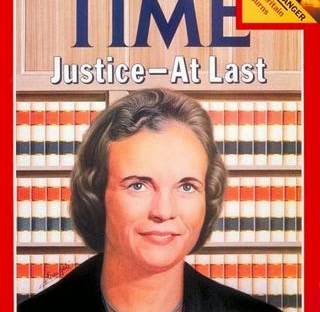
On September 21, 1981, the Senate voted 99-0 to confirm Sandra Day O’Connor as the first woman on the United States Supreme Court. President Ronald Reagan nominated O’Connor in August 1981 as the fulfillment of his 1980 campaign promise to appoint the first woman to the nation’s highest court.

During her 25 years on the Court, she played a crucial role in decisions on abortion, affirmative action, the death penalty, among many others. O’Connor’s status as the first woman on the court, combined with “a gregarious public presence unusual for the government’s most monastic branch, made her unquestionably the best-known justice in modern times, greeted by strangers in airports and on the streets and always named on pollsters’ lists of America’s most powerful and most respected women.”

She also received a lot of attention as the Court’s “swing vote” (a place now occupied by Justice Anthony Kennedy).

“O’Connor arrived on an ideologically divided high court during a period of unprecedented challenge to established law on issues such as abortion, affirmative action, church-state relations and criminal justice.

She put her stamp on each of these fields, not by adopting an agenda, but by avoiding one. With colleagues often locked into predictable conservative or liberal position, this made her a consistent swing vote, a strategic role she deployed to moderate the extremes, in case after controversial case.”

When she submitted her resignation to President George W. Bush in 2005, the president spoke to O’Connor by telephone from the Oval Office in what was described as an “emotional call.” Bush reportedly told O’Connor “You are one of the great Americans. . . . I wish I was there to hug you.”

After retiring to take care of her now late husband, Justice O’Connor turned her time and attention to civics education. O’Connor is undoubtedly the nation’s highest profile champion of civics education. In 2009, Justice O’Connor founded iCivics in an effort to restore civic education in our nation’s schools. iCivics has gone on to become one of the leading organizations in the effort to educate young people about our nation’s system of government.

O’Connor famously said that: “It is imperative if we are going to survive as a nation that our schools teach civics. Knowledge and understanding about our system of government is not something that’s handed down in the gene pool. You have to learn it.”

On the 35th anniversary of Justice O’Connor’s confirmation as the first woman on the United States Supreme Court, I hope we will celebrate not only her contributions to the nation’s highest court, but also her continued contributions to civic knowledge and engagement. I hope that other justices on the Court follow in her footsteps – Justice Sotomayor already has by agreeing to serve on iCivics’ governing board.