You Can’t Defend What You Don’t Understand: A Plea for Support of Civics Education

There is an often-told story that at the end of the Constitutional Convention, Benjamin Franklin was approached by a woman who asked him what sort of government the delegates had created. Franklin famously replied, “A republic, if you can keep it.”

To keep it, we must teach it. You cannot defend what you do not understand. And so in order for citizens to defend the Constitution and the Bill of Rights, they must first understand it.

James Wilson, a founding father from Pennsylvania, once said that “[l]aw and liberty cannot rationally become the objects of our love, unless they first become the objects of our knowledge.”

And, yet, countless reports and studies confirm that American citizens of all ages lack a basic understanding of our nation’s history and form of government. A survey released last year by the Annenberg Public Policy Center at the University of Pennsylvania found that –

  • Only one in three Americans could name all three branches of the U.S. government, while just as many could not identify even one; and,
  • And about one in 10 Americans say the Bill of Rights includes the right to own a pet.

Additionally, across the nation, school boards and colleges and universities are cutting civics and history programs and young citizens are, as a result, losing the opportunity to study our nation’s Constitution and history. We are not only failing to teach our citizens about U.S. history and the Constitution in primary and secondary school, but also in college. The American Council of Trustees and Alumni found that only approximately 18.3% of colleges and universities require even a single foundational course in American government in history.

If you believe in defending the United States Constitution, then you also have to invest in civics education and constitutional literacy. You can help do this by investing in ConSource and other non-profits invested in promoting knowledge about the U.S. Constitution and our system of government.

New Resource for High School Teachers: Constitutional Convention Simulation

I’m presenting at the National Council for the Social Studies annual conference in Washington, DC this weekend on ConSource’s new Choosing to Make a Nation Curriculum project, and in particular our Constitutional Convention unit, which is now available for free download. More information about both is provided below. This is an outstanding resource for high school government and history teachers!

Choosing to Make a Nation: Interactive Lessons on the Revolution, Constitution, and Bill of Rights

The Choosing to Make a Nation Curriculum Project developed by award-winning author Ray Raphael is a student-centered, primary source-rich approach to teaching about American history and our nation‘s founding documents. The lesson plans in this curriculum are premised on the idea that history is the chronicle of choices made by actors/agents/protagonists in specific contexts. Students understand choices – they make them all the time. These lessons involve students by placing them in the shoes of historical people and asking: “What might you do in such instances?”

For these exercises to be historical (more than affirmations of individual whims), we needed to provide context: what was the issue, the problem to be solved? What were the existing realities/constraints that limited possibilities? With those in mind, what were the available options? For each option, how did people view the possibilities for a desired outcome? What were the potential dangers? When studying battles, we see how generals evaluate troop strengths, positioning, logistics, morale, and so on. In fact, all historical actors do this—not just leading political figures, but ordinary people and collective bodies. In Revolutionary times, people often made decisions in groups, both indoors (town meetings, caucuses, conventions, congresses) and “out-of-doors,” as they said at the times, informal gatherings that protested authority or enforced popular will. Individuals, forced to navigate the troubled waters of those days, also faced momentous decisions.

Our task is to introduce students to historical protagonists who confronted such choices. Points of decision create teachable moments. We help students imagine, from a distant time, the hopes of these people, but also their constraints. With these protagonists, students explore the available options. Having skin in the game, they will better understand why people acted as they did. They will think more deeply about the paths actually taken — how events ensued, the consequences of decisions, and the subsequent issues these created. By exercising individual and group decision-making skills within political contexts, they prepare for civic life.

The Constitutional Convention unit is now available for free download here.

Other units will be published online once completed, and include: The Road to Revolution; The Declaration of Independence, The Revolutionary War; Articles of Confederation and State Constitutions; Ratification of the Constitution; the Bill of Rights; and the Constitution in Action.

Constitutional Convention Simulation

Basic Structure for Choice-Centered Lessons

  • Formulate the problem, the issue at hand; define the players; provide context.
  • Outline and discuss the available options.
  • Individuals or groups make and reveal their choices.
  • Presentation of the historical outcome: the choice actually made by the players – using historical documents whenever possible.
  • Analysis of the historical outcome.

Infrastructure for the Constitutional Convention Simulation

  • The eight lessons can be used individually or as a unit. In either case, here are the basic rules of operation.
  • Assign each student to a state delegation in 1787 Federal Convention in Philadelphia. You can also allow students to choose their states. Students should sit with their fellow state delegates.
  • Break groups, called “discussion and debate” (D&D) groups will be comprised of several state delegations from diverse regions: lower South, upper South, mid-Atlantic, New England. These should be small enough to allow each student to participate. The number of state delegations represented in each group will vary according to class size.
  • Each time students meet in their D&D groups, they should be reminded that these are for deliberations only. The groups do not have to come to any agreements. Students will not be casting votes in these groups.
  • Students will vote by state delegation – one vote for each state delegation, just as it was at the Federal Convention of 1787. If delegates of any state are evenly divided on an issue, they report “divided” as their state’s vote.

If you plan to teach each lesson in the unit, here is the suggested order:

  1. Reform or Revolution? (one-day and two-day options)
  2. Composition of Congress (one-day and two-day options)
  3. Creating an Executive (one-day and two-day options)
  4. Should Judges Judge Laws? (one-day lesson)
  5. Fine Tuning the Balance of Powers (one-day and two-day options)
  6. Slavery at the Constitutional Convention (two-day lesson)
  7. Amendments and Ratification (one-day and two-day options)
  8. To Sign or Not To Sign
    1. Option A: The Historical Constitution (one-day lesson)
    2. Option B: The Student-Generated Constitution (one-day lesson)
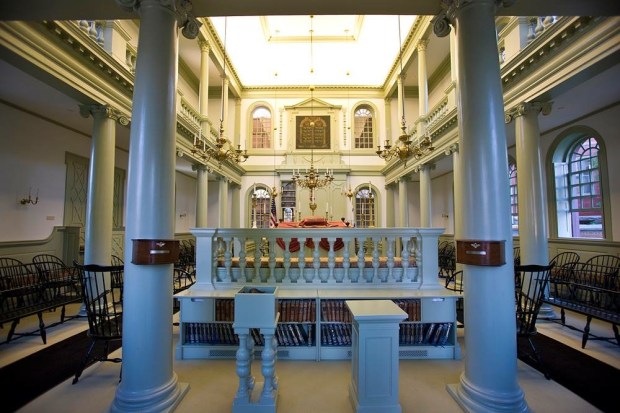
 

The Oldest Synagogue in America was Dedicated On This Day in 1763

Touro Synagogue was dedicated on December 2, 1763 in Newport, Rhode Island. It is the oldest synagogue building in the United States.

img_1749

The congregation was founded in 1658 by the descendants of Jewish families who fled the Inquisitions in Spain and Portugal and who themselves left the Caribbean seeking the greater religious tolerance that Rhode Island offered.

One of my favorite historical documents is the letter George Washington wrote to the congregants of Touro Synagogue in August of 1790 discussing religious liberty and toleration.

“Gentlemen:

While I received with much satisfaction your address replete with expressions of esteem, I rejoice in the opportunity of assuring you that I shall always retain grateful remembrance of the cordial welcome I experienced on my visit to Newport from all classes of citizens.

The reflection on the days of difficulty and danger which are past is rendered the more sweet from a consciousness that they are succeeded by days of uncommon prosperity and security.

If we have wisdom to make the best use of the advantages with which we are now favored, we cannot fail, under the just administration of a good government, to become a great and happy people.

The citizens of the United States of America have a right to applaud themselves for having given to mankind examples of an enlarged and liberal policy—a policy worthy of imitation. All possess alike liberty of conscience and immunities of citizenship.

It is now no more that toleration is spoken of as if it were the indulgence of one class of people that another enjoyed the exercise of their inherent natural rights, for, happily, the Government of the United States, which gives to bigotry no sanction, to persecution no assistance, requires only that they who live under its protection should demean themselves as good citizens in giving it on all occasions their effectual support.

It would be inconsistent with the frankness of my character not to avow that I am pleased with your favorable opinion of my administration and fervent wishes for my felicity.

May the children of the stock of Abraham who dwell in this land continue to merit and enjoy the good will of the other inhabitants—while every one shall sit in safety under his own vine and fig tree and there shall be none to make him afraid.

May the father of all mercies scatter light, and not darkness, upon our paths, and make us all in our several vocations useful here, and in His own due time and way everlastingly happy.

G. Washington”

Rosa Parks and the Other Women Who Fought to End Segregation in Public Transporation


Rosa_Parks_Booking.jpg

On this day in 1955, in Montgomery, Alabama, Rosa Parks is jailed for refusing to give up her seat on a public bus to a white man. She was arrested for violating a city law requiring segregation on public buses. On city buses in Montgomery, Alabama, the front 10 seats were permanently reserved for white passengers. Park was actually seated in the first row behind the 10 seats reserved for white passengers, but when the bus became crowded, the driver asked her and three other African American passengers to move. Eventually the other three passengers moved, but Parks remained seated, arguing she was not in a seat reserved for white passengers. The driver said he had discretion to move the racial line separating white and black passengers on his bus, and called the police when Parks refused to move.

Parks was arrested and charged with “refusing to obey orders of bus driver.” She was not the first black person in Montgomery, Alabama arrested for violating the city bus segregation laws. Her arrest made a huge impact in large part due to her stature in the civil rights community. She was an active member of the local National Association for the Advancement of Colored People (NAACP), and served as secretary to E.D. Nixon, then president of the Montgomery chapter.

Parks’ arrest became the catalyst for the African American community to organize a sustained bus boycott to protest discrimination and segregation laws on public transportation. Martin Luther King, Jr., then only 26 years old, emerged as the leader of a 381 day peaceful, well-organized boycott that captured the nation’s attention.

Browder v. Gayle: The Other African American Women Who Fought Segregation on Public Transportation

While Rosa Parks’ act of civil disobedience was unquestionably the act that galvanized the African American community to engage in a sustained bus boycott, it was the acts of four other African American women – Aurelia Browder, Susie McDonald, Claudette Colvin and Mary Louise Smith — who served as plaintiffs in a court case challenging Montgomery’s segregated public transportation system after each had been arrested. Their case Browder v. Gayle went all the way to the United States Supreme Court, where the Court held in a per curiam opinion that racially segregated transportation systems enforced by the government violate the Equal Protection clause of the Fourteenth Amendment.

The District Court opinion, upheld by the Supreme Court, described the case this way –

The purpose of this action is to test the constitutionality of both the statutes of the State of Alabama[1] and the ordinances of the City of Montgomery[2] which require the segregation of the white and colored races on the motor buses of the Montgomery City Lines, Inc., 711*711 a common carrier of passengers in said City and its police jurisdiction.

The plaintiffs are four Negro citizens who bring this action for themselves and on behalf of all other Negroes similarly situated.[3] The defendants are the members of the Board of Commissioners and the Chief of Police of the City of Montgomery, the members of the Alabama Public Service Commission, The Montgomery City Lines, Inc., and two of its employee drivers.

Each of the four named plaintiffs has either been required by a bus driver or by the police to comply with said segregation laws or has been arrested and fined for her refusal so to do. The plaintiffs, along with most other Negro citizens of the City of Montgomery, have since December 5, 1955, and up to the present time, refrained from making use of the transportation facilities provided by Montgomery City Lines, Inc. Plaintiffs and other Negroes desire and intend to resume the use of said buses if and when they can do so on a non-segregated basis without fear of arrest.