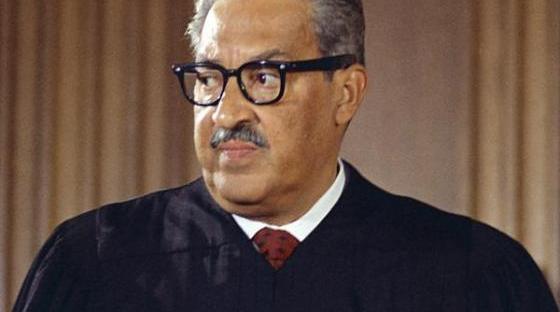
Thurgood Marshall was Sworn in as the First Black U.S. Supreme Court Justice 49 Years Ago Today

On October 2, 1967, Thurgood Marshall was sworn in by Chief Justice Earl Warren as the first black United States Supreme Court Justice. On August 30 of that year, after heated debate, the Senate voted 69 to 11 to confirm his nomination to the Supreme Court by President Lyndon Baines Johnson.

Marshall was the great-grandson of a slave, who spent most of his career fighting for civil rights. He served as chief counsel for the National Association for the Advancement of Colored People (NAACP) in the 1940s and 1950s, where he was the architect of the legal strategy that ended the era of state-sanctioned segregation. The most notable case he argued and won was Brown v. Board of Education of Topeka. In Brown, the Supreme Court held that separate but equal educational facilities for racial minorities is inherently unequal violating the Equal Protection Clause of the Fourteenth Amendment.

In 1961, Marshall was appointed by John F. Kennedy to the United States Court of Appeals for the Second Circuit. He wrote over 150 decisions on a number of important constitutional matters while on the Second Circuit. In 1965, President Lyndon Johnson appointed Marshall to the office of U.S. Solicitor General, where he again successfully argued cases before the United States Supreme Court.

On June 13, 1967, Johnson nominated Marshall to fill the seat of retiring Supreme Court Justice Tom Clark. Of his decision to appoint Marshall as the first black Supreme Court Justice, Johnson said it was “the right thing to do, the right time to do it, the right man, and the right place.”

Marshall served on the Supreme Court for 23 years, and retired in October 1991.

When Marshall died two years later in 1993, then-Chief Justice William Rehnquist said at his funeral service “As a lawyer and judge, Thurgood Marshall left an indelible mark, not just on the law, but on his country.”


Event Announcement: I’m Speaking on a Panel About George Mason at the National Constitution Center on October 5

Event Information (including how to register) available here and below

THE RELUCTANT STATESMAN: GEORGE MASON AND THE AMERICAN TRADITION OF DISSENT

Wednesday, October 5, 2016 at 12 – 2:30 p.m.

National Constitution Center

525 Arch Street | Philadelphia, PA

Admission: Free


In a special afternoon symposium, acclaimed historians and scholars Fergus Bordewich, Linda Monk, Julie SilverbrookStephen Solomon, David O. Stewart, and Ralph Young discuss George Mason — one of the three dissenters of the Constitution — and the role dissent has played in shaping America. This program is presented in partnership with George Mason’s Gunston Hall.

12:00 – 12:05 p.m.: Welcome Remarks
Scott Stroh, Executive Director, Gunston Hall

12:05 – 12:20 p.m.: Keynote Address
Tom Donnelly, Senior Fellow for Constitutional Studies, National Constitution Center

12:20 – 1:20 p.m.: George Mason and America’s Founding: Mason’s Constitutional Legacy
Historians David O. Stewart and Fergus Bordewich, and Julie Silverbrook, executive director of The Constitutional Sources Project, discuss Mason’s constitutional legacy, including his influence on the Declaration of Independence, the U.S. Constitution, and the Bill of Rights, and his relationship with key Founding Fathers. Scott Stroh, executive director at Gunston Hall, moderates.

1:30 – 2:30 p.m.: George Mason, the First Amendment, and the American Tradition of Dissent
Constitutional scholar Linda Monk, Stephen Solomon, author of Revolutionary Dissent: How the Founding Generation Created the Freedom of Speech, and Ralph Young, author of Dissent: The History of an American Idea, discuss Mason’s role as a key dissenter, the birth of the First Amendment, and the importance of the tradition of dissent in American history. Michael Gerhardt, scholar-in-residence at the National Constitution Center, moderates.

Watch live on October 5 at noon: http://constitutioncenter.org/calendar/the-reluctant-statesman-george-mason-and-the-american-tradition-of-dissent